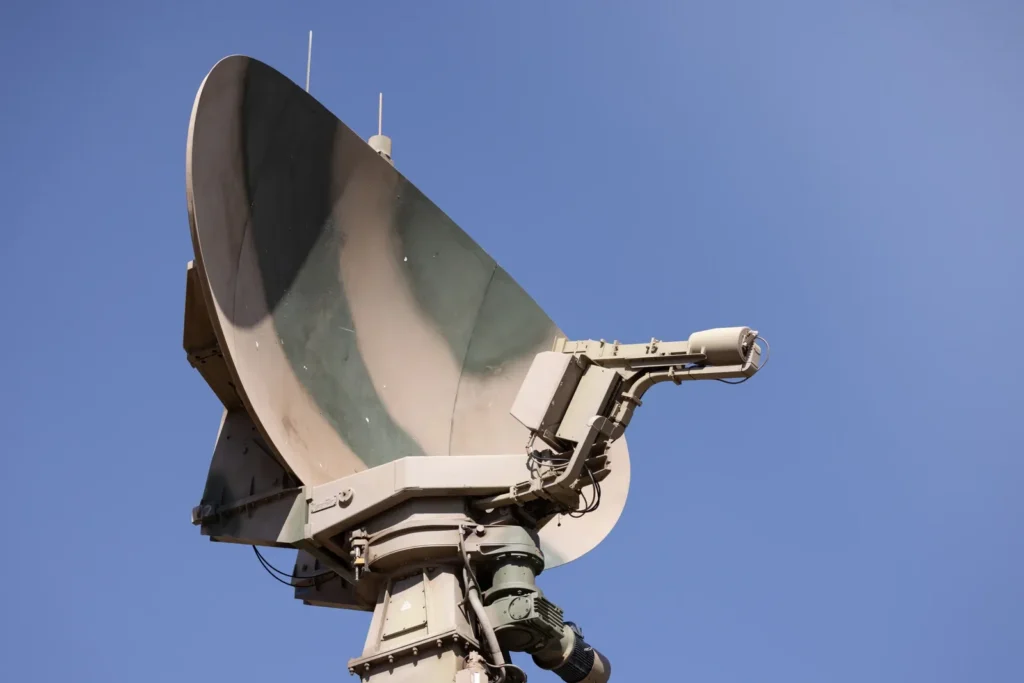

Signals intelligence (SIGINT) is, in the NSA’s words, “intelligence derived from electronic signals and systems used by foreign targets, such as communications systems, radars, and weapons systems.” So what is SIGINT in plain terms? Whatever can be learned from a foreign target’s signals, without a human source.
Defense Department doctrine (Joint Pub 1-02) names three parts, communications intelligence, electronics intelligence and foreign instrumentation signals intelligence, collected “individually or in combination” and “however transmitted.” The NSA’s 2026 Signals Analyst job posting defines each one:
- COMINT (communications intelligence): “technical and intelligence information derived from foreign communications.”
- ELINT (electronic intelligence): “technical and geolocation information derived from foreign non-communication electromagnetic emissions,” such as radars, weapons systems, beacons and navigation systems.
- FISINT (foreign instrumentation signals intelligence): information from foreign emissions “associated with the testing and operational deployment of foreign aerospace, surface and subsurface systems.”
Official 2026 recruiting pages, put side by side, add a practical number. From the day a recruit ships to basic training, the first SIGINT job is 4 to 8 months away on analyst tracks and 12 to 22 months on linguist tracks, which add the Defense Language Institute (DLI). The extremes: about 4 months for an Air Force 1N2X1 and about 22 for an Army 35P with a Category IV language.
In uniform, military SIGINT is an enlisted job family: the Army’s 35-series, the Navy’s Cryptologic Technician ratings, the Air Force 1N field and a Space Force specialty.
Which Military Jobs Do Signals Intelligence?
Every branch has enlisted SIGINT jobs, each tied to a code: the Army calls it a military occupational specialty (MOS), the Navy a rating and the Air Force an AFSC. Navy CTRs “serve as experts in intercepting signals of all types,” while Air Force 1N4X1 fusion analysts “determine the value and implications of intelligence.”
| Branch | Code | Job | Language job? | Entry scores |
|---|---|---|---|---|
| Army | 35N | Signals Intelligence Analyst | No | ST 112 |
| Army | 35S | Signals Analyst | No | ST 101 |
| Army | 35P | Signals Intelligence Voice Interceptor | Yes | ST 101 + DLAB 85, or ST 129 |
| Navy | CTR | Cryptologic Technician Collection | No | n/p |
| Navy | CTT | Cryptologic Technician Technical | No | n/p |
| Navy | CTI | Cryptologic Technician Interpretive | Yes | MK+VE 126, or 108 + DLAB 110 |
| Air Force | 1N2X1 | Signals Intelligence Analyst | No | n/p |
| Air Force | 1N3X1 | Cryptologic Language Analyst | Yes | General 62 |
| Air Force | 1N4X1 | Cyber Intelligence Analyst | No | General 62 |
| Space Force | Not listed | Signals Intelligence Analyst | No | General 72 |
| Marine Corps | See marines.mil | SIGINT/EW field | n/p | n/p |
Sources: goarmy.com, navy.com, airforce.com, spaceforce.com and MyNavyHR, as of October 14, 2026; n/p = not published. CTI scores are for Sailors converting in. Navy CTN is now Cyber Warfare Technician, a cyber rating.
But here’s the thing. Choosing analyst or linguist matters more than choosing a branch, because language tracks add 36 to 64 weeks of DLI. The 35N MOS and the cryptologic technician ratings CTR and CTT skip that phase.
Officers lead through a separate commissioning track; the enlisted vs. officer comparison explains the difference.
How Long Does It Take to Reach Your First SIGINT Job?
About 4 months on the fastest analyst track, and up to about 22 on a Category IV language track. An Air Force SIGINT analyst (1N2X1) gets there first: 7.5 weeks of basic plus 74 to 84 days at Goodfellow AFB. The 35P MOS sits at the far end, because DLI comes before its AIT.

| Job | Basic, wk | School | Total, wk | Months from ship date |
|---|---|---|---|---|
| Air Force 1N2X1 | 7.5 | 74–84 days | 18.1–19.5 | 4.2–4.5 |
| Navy CTT | 9 | A school 12 wk | 21 | 4.8 |
| Army 35S | 10 | AIT 15 wk | 25 | 5.7 |
| Navy CTR | 9 | A school 18 wk | 27 | 6.2 |
| Air Force 1N4X1 | 7.5 | 135 days | 26.8 | 6.2 |
| Space Force SIGINT Analyst | 7.5 | 5 months + ISR phase (n/p) | 29.2+ | 6.7+ |
| Army 35N | 10 | AIT 24 wk | 34 | 7.8 |
| Army 35P | 10 | DLI 36–64 + AIT 5–20 wk | 51–94 | 11.7–21.6 |
| Navy CTI | 9 | DLI 36–64 + Goodfellow 13 wk | 58–86 | 13.3–19.8 |
| Air Force 1N3X1 | 7.5 | DLI 36–64 wk + 110 days | 59.2–87.2 | 13.6–20.1 |
| Marine Corps SIGINT/EW | 13 + MCT 29 days | MOS school n/p | 17.1+ | 3.9+ before MOS school |
How the numbers were calculated: weeks of basic plus school weeks (days divided by 7), converted at 30.44 days per month. DLI uses the 36 to 64 week range from the DLIFLC language list for every branch. Not included: time in the Delayed Entry Program, travel between schools and holdover while waiting for a class or a clearance.
Here’s where it gets interesting. The airforce.com page for 1N3X1 lists only 110 days at Goodfellow and never mentions DLI, yet AETC’s 517th Training Group trains Air Force cryptologic language analysts at both the Presidio of Monterey and Goodfellow. Read the recruiting page alone and the job looks about 5 months away, while the real track runs 13 to 20.
So the language decides the timeline more than the branch does. A Category IV language such as Arabic or Korean means 28 more weeks of DLI than Spanish or French.
What Clearance Does a SIGINT Job Require?
SIGINT jobs require eligibility for Top Secret/SCI. The Navy’s CTR page asks for eligibility for a “Top Secret/Sensitive Compartmented Information security clearance,” and the Air Force and Space Force pages add a polygraph and a single scope background investigation (SSBI).
The confirmed steps:
- U.S. citizenship (Air Force and Space Force pages).
- A background investigation (SSBI).
- A polygraph (Air Force and Space Force).
- Navy CTI: no security waivers, and family members must be U.S. citizens or from ICD 704 “Low” list countries.
Here’s what the data actually shows. Initial Top Secret clearances averaged 205 days end-to-end for the fastest 90% of cases in the latest federal data, about 29 weeks. That’s longer than most analyst pipelines (18 to 27 weeks), so an analyst can finish school before the clearance closes.
The investigation phase for High Risk cases fell to 60 days in FY26-Q3, but that metric leaves out SCI adjudication and the polygraph. Nobody can predict whether a given recruit waits in holdover. That’s why filling out the SF-86 completely and honestly is really about time.
How Much Does a Signals Intelligence Analyst Make?
There’s no separate SIGINT analyst salary. Pay is basic pay set by rank and years of service, plus allowances and bonuses, and basic pay rose 3.8% on January 1, 2026, per the Congressional Research Service. DFAS publishes the dollar amounts by grade.
Here’s the part most people miss. For a cryptologic linguist, the language test score turns into monthly cash through the Foreign Language Proficiency Bonus (FLPB), paid per skill under DoD Instruction 1340.27:
| ILR level, per skill | FLPB per month |
|---|---|
| 2 | Up to $100 (service may set $0, $50 or $100) |
| 2+ | $200 |
| 3 | $300 |
| 3+ | $350 |
A linguist certified at 2+ in listening and reading draws $400 a month, or $4,800 a year. At level 2, the same linguist gets $200 at most. Title 37 of the U.S. Code caps FLPB at $1,000 a month and $12,000 a year.
The Army also advertises bonuses of up to $20K for 35P and 35W as of October 2026, though bonus offers change.
SIGINT vs. HUMINT: How Is It Different?
SIGINT collects from signals, and HUMINT collects from people. ELINT isn’t a separate discipline next to SIGINT; it’s one of its three parts. Measurement and signature intelligence (MASINT) is its own discipline, not a subset of SIGINT.
GEOINT works from imagery, and OSINT from public information.
But the real question is this: what do signals add? SIGINT can reveal what foreign targets intend and what they’re capable of, often before they act. That makes it a core source of early warning.
Who Collects SIGINT, and Is It Legal?
The National Security Agency is the lead U.S. agency for SIGINT. It was created in 1952 by order of President Truman, and Executive Order 12333 assigns NSA the “collection of signals intelligence information for national foreign intelligence purposes.”
Is SIGINT legal? Yes for foreign targets, with limits for Americans. Under EO 12333, information about U.S. persons can be collected only under procedures “approved by the Attorney General.”
But there’s a catch. Congress created the Foreign Intelligence Surveillance Court in 1978 with the Foreign Intelligence Surveillance Act (FISA), and it reviews collection “principally when they are conducted in the United States or directed at U.S. persons.” So the line is about whose communications are targeted, not the technology.
What Do Recruits Get Wrong About SIGINT Jobs?
Three assumptions trip up recruits:
- “Signal intelligence means the Signal Corps.” It doesn’t. The Army’s 25-series jobs handle communications, while goarmy.com files 35N, 35S and 35P under signal intelligence.
- “The clock starts at MEPS.” It starts at shipping, and the Delayed Entry Program can last up to 365 days, extendable by up to 365 more under 10 U.S.C. §513(b).
- “A Navy CTI’s obligation starts after training.” Per the MyNavyHR checklist, the five-year obligation runs from the start of the language course.
Which SIGINT Path Fits You?
Want a language? Look at 35P, CTI and 1N3X1, plan on roughly 12 to 22 months of training, and treat FLPB as the reason to push for 2+.
Want to reach the job faster? The analyst tracks 1N2X1, CTT, 35S and CTR run about 4 to 6 months, though the clearance can take longer than the school.
Not sure SIGINT fits? The combat medic guide breaks down another enlisted job the same way.
Frequently Asked Questions
What does SIGINT stand for?
SIGINT stands for signals intelligence. It covers intelligence derived from electronic signals and systems used by foreign targets, from communications to radars and weapons systems.
The term groups three parts: COMINT, ELINT and FISINT. In the U.S., NSA is the lead agency, and the Army, Navy, Air Force, Space Force and Marine Corps all have enlisted SIGINT jobs.
What is the difference between ELINT and SIGINT?
ELINT is part of SIGINT, not a separate discipline. Defense Department definitions build SIGINT from communications intelligence, electronics intelligence and foreign instrumentation signals intelligence, alone or in combination.
ELINT, sometimes searched as electronic signals intelligence, covers foreign non-communication emissions such as radars, weapons systems, beacons and navigation systems. COMINT, by contrast, deals with foreign communications.
What is an example of SIGINT?
The official definitions give three clean examples. Intercepted foreign communications are COMINT.
Emissions from a foreign radar or weapons system are ELINT. Signals intercepted while a foreign aerospace system is being tested fall under FISINT.
How long is DLI for a cryptologic language job?
It depends on the language. DLIFLC courses run 36 weeks for Category I and II languages such as Spanish, French and Indonesian, 48 weeks for Category III languages such as Russian and Persian Farsi, and 64 weeks for Category IV languages such as Arabic, Mandarin, Japanese and Korean.
The Navy’s CTI checklist puts DLI at 9 to 18 months, followed by about 3 months at Goodfellow AFB. After DLI, Army 35P linguists go on to AIT, and Air Force linguists go to Goodfellow.
Is SIGINT still used today?
Yes. The NSA opened a Signals Analyst job announcement in June 2026, and the Army, Navy, Air Force and Space Force all list SIGINT jobs on their recruiting sites as of October 2026.
Executive Order 12333 still assigns SIGINT collection to NSA. Even the Space Force recruits its own SIGINT analysts, with ISR training at Peterson SFB after Goodfellow.
Sources
- National Security Agency, “Signals Intelligence Overview,” nsa.gov
- NSA/CSS via USAJOBS, “Signals Analyst,” announcement 1259422, June 2026
- National Archives, “Executive Order 12333: United States Intelligence Activities,” 1981
- Defense Language Institute Foreign Language Center, “Languages at DLIFLC”
- Performance.gov, “QPR Legacy Metrics FY26-Q2,” Personnel Vetting, 2026
- Department of Defense, “DoD Instruction 1340.27: Foreign Language Proficiency Bonus,” 2022