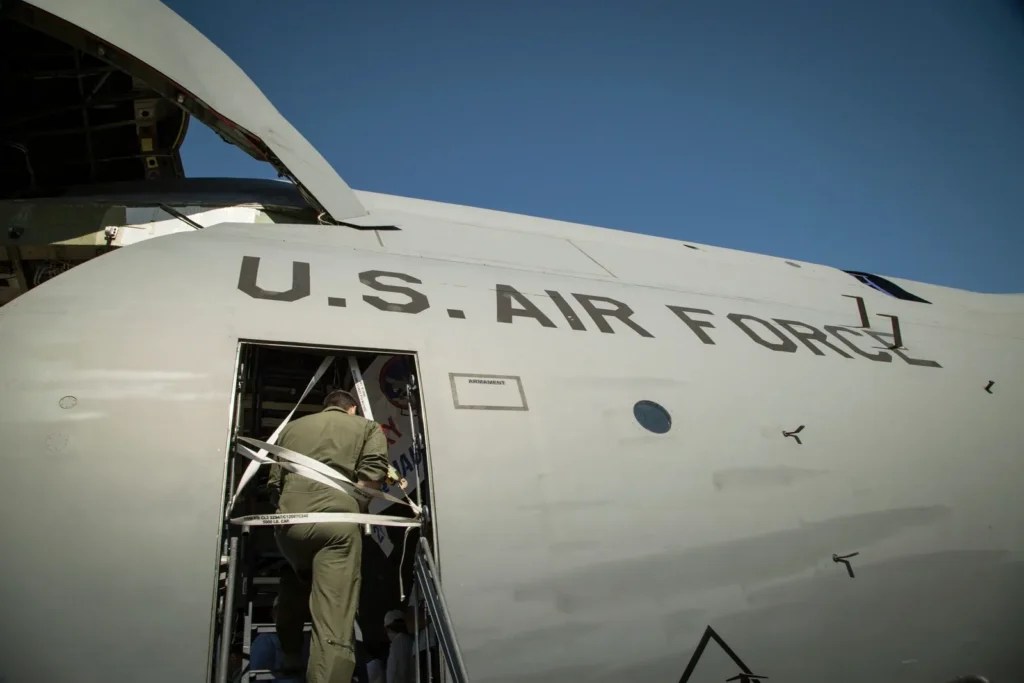
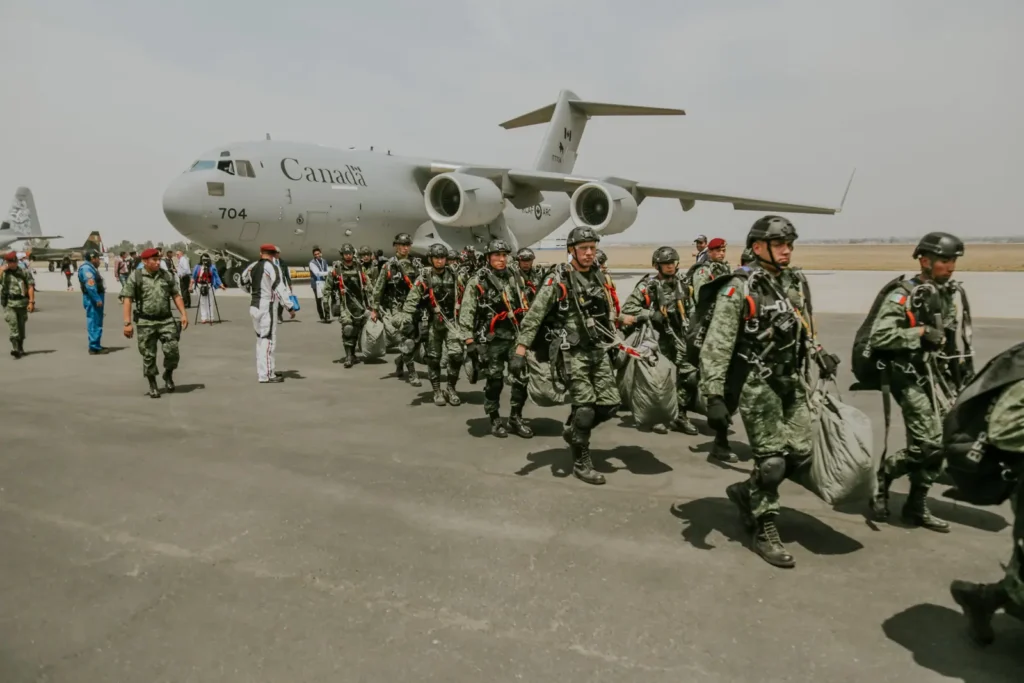

A military deployment is the movement of service members away from their home base to support a mission. That’s the short deployment meaning, and it comes with one correction right away: not every deployment is combat.
How long does it last? Most run six to nine months, and some last a year or more, depending on the branch and the job.
On a seven-month combat-zone deployment, an E-4 and an O-3 get the same cash add-on: $525 a month with dependents. Tax doesn’t split them either: in a combat zone, every dollar of base pay is tax-free for both. Those figures come from the 2026 DFAS pay tables and DoD pay regulations, and the pay section below shows the math.
What Does Military Deployment Actually Mean?
Military OneSource puts it simply: a military deployment is the movement of armed forces to support a mission. Not all deployments are combat related. The clock starts when service members leave their home installation.
The missions behind those orders vary. Military OneSource lists these types:
- An enduring mission
- Humanitarian aid
- Evacuation of U.S. citizens
- Restoring peace to a region
- Increased security
So what is deployment in legal terms? Federal law (10 U.S.C. §991(b)) counts a service member as deployed on any day they’re under orders, for training or an operation, and can’t spend the night at their residence at their permanent duty station. Schooling and garrison duty don’t count.
Three other terms often get mixed up with it.
| Term | What it is | How long | Source |
|---|---|---|---|
| Deployment | Movement of forces away from the home installation to support a mission | Depends on branch and mission (see the next section) | Military OneSource |
| TDY | A temporary duty assignment away from the permanent station that ends with a return home | Temporary | Plain-language summary |
| PCS | A permanent move to a new duty station | Permanent | Plain-language summary |
| Mobilization (Guard and Reserve) | Involuntary call-up of Guard or Reserve members | Up to 24 consecutive months in a national emergency (10 U.S.C. §12302), or up to 365 consecutive days for preplanned missions (10 U.S.C. §12304b) | U.S. Code |
Temporary duty has its own rules, covered in this guide to what TDY means.
How Long Are Deployments in Each Branch?
Most deployments last six to seven months at sea and nine months on the ground for Army units, and some jobs run longer. Every branch builds its schedule differently, and Military OneSource adds one warning for all of them: deployment extensions can happen.

| Branch | Typical length | What it usually looks like | Source |
|---|---|---|---|
| Army | 9 months boots on the ground; 12 months for corps level and above and individual augmentees | Unit rotations under a policy in place since 2012 | army.mil (2011) |
| Marine Corps | 6 to 7 months of deployment after one year of training; some scheduled for one year or more | Many deploy on Navy ships, though some fly | Military OneSource (2026) |
| Navy | 6 or 7 months on ships and subs, occasionally longer; as little as 30 days or more than a year without a ship | Port calls break up time at sea | Military OneSource (2026) |
| Air Force | 6 to 12 months, or a series of 2- to 3-month deployments in quick succession | Often a flight to an overseas Air Force base or joint base; tempo depends on job and unit | Military OneSource (2026) |
| Space Force | Usually no classic overseas deployment | Most operations run from home station | Air & Space Forces Magazine (2024) |
| Coast Guard | A few days to several months | Aboard cutters, in maritime operations or on TDY, depending on mission and unit | Military OneSource (2026) |
Two single-unit examples show how specific these numbers get. In 2013, a Marine reserve unit went on a six-month Unit Deployment Program rotation to Okinawa, Japan. In May 2026, the Coast Guard Cutter Waesche returned to Alameda after a 113-day patrol in the Bering Sea.
How Long Is Deployment in the Army?
How long are army deployments today? Since January 1, 2012, the standard has been nine months boots on the ground, according to the Army. Units at corps level and above, plus individual augmentees, stayed at 12 months.
Every army deployment still depends on what commanders need. So the nine-month figure is policy since 2012, not a guarantee.
Navy Deployment Length: Plan vs. Reality
On paper, ship and submarine deployments typically last six or seven months. And it gets more complicated. The carrier USS Gerald R. Ford left on June 24, 2025, and returned to Norfolk on May 16, 2026, a deployment of 326 days.
That’s 113 days, or 53%, longer than a seven-month (213-day) plan, about 10.7 months in total. The Congressional Research Service calls it the longest carrier deployment since Vietnam.
Guard, Reserve and Space Force
Army Guard and Reserve soldiers may be mobilized for 12 months or more, yet spend nine of those months deployed. Space Force works differently: “Most Space Force operations are conducted at home station,” Air & Space Forces Magazine reported in 2024. Its units cycle through readiness phases rather than classic overseas deployments, as the next section shows.
How Long Are You Home Between Deployments?
The Defense Department’s goal is three times as long at home as deployed, and the floor is twice as long. Planners call that ratio dwell time, and the current policy dates to August 25, 2025, according to the Congressional Research Service.
For active-duty troops, the goal is 1:3 or better and the threshold is 1:2. Guard and Reserve members are measured by mobilization-to-dwell, with a goal of 1:5 and a threshold of 1:4. Going below the threshold takes approval from the Secretary.
Home-time figures below multiply the deployment length by DoD’s 1:2 and 1:3 ratios (Guard and Reserve 1:4 and 1:5), calculated on October 17, 2026.
| Deployment or mobilization | Minimum time home (threshold) | DoD goal |
|---|---|---|
| 6 months, active duty | 12 months | 18 months |
| 7 months, active duty | 14 months | 21 months |
| 9 months, active duty (Army boots on the ground) | 18 months | 27 months |
| 12 months, active duty | 24 months | 36 months |
| 9-month Guard or Reserve mobilization | 36 months not mobilized | 45 months not mobilized |
| 12-month Guard or Reserve mobilization | 48 months not mobilized | 60 months not mobilized |
These are planning targets, not a guarantee.
Federal law also sets deployment thresholds in 10 U.S.C. §991: 220 deployed days out of 365, and 400 out of 730. Those statutory thresholds have been suspended since October 8, 2001, but DoD Instruction 1336.07 keeps the 400-of-730 threshold.
How Each Branch Builds Its Deployment Cycle
Each branch turns that policy into its own deployment cycle:
- Air Force (AFFORGEN): a 24-month cycle of four six-month phases, one of them “Available to Commit,” which works out to 1:3.0 (af.mil, 2021).
- Navy (OFRP): a 36-month cycle with seven-month deployments for amphibious ships, which leaves 29 months not deployed, about 1:4.14 on paper (Breaking Defense, 2026).
- Space Force (SPAFORGEN): prepare runs 21 days, ready 42 and commit 105, as Air & Space Forces Magazine reported in 2024. The commit phase isn’t an overseas deployment length.
What Are the Deployment Phases, Step by Step?
Military OneSource notes that “military deployments span the time before and after the actual period when the service member is away.” For the service member and family, the deployment phases run in four steps:
- Predeployment. Before leaving, service members undergo special training, briefings, medical evaluations and counseling.
- During deployment. The time away on the mission itself.
- Reunion. The return home.
- Reintegration. Settling back in, covered in its own section below.
For Army units, predeployment training can happen at the National Training Center, the Joint Readiness Training Center or other centers. Military OneSource says “an average deployment cycle will include months of training at their home base and at these specialized courses.”
During the deployment itself, a break home isn’t automatic. By law (10 U.S.C. §705a), the Secretary “may provide” up to 15 days of rest and recuperation absence plus a government-paid round trip for members serving at least 270 days in a combat zone where hardship duty pay is authorized. That time comes in addition to other leave.
Different sources count the stages differently. They’re three lenses on the same event, not contradictions.
| Lens | Stages | Focus | Source |
|---|---|---|---|
| Service member and family | Predeployment, during deployment, reunion, reintegration | What the person and household go through | Military OneSource (2026) |
| Unit logistics | Planning, Pre-Deployment Activities, Movement, Reception/Staging/Onward Movement (RSOI), Redeployment | Moving the unit | Army Deployment Handbook, CALL No. 25-08 (April 2025) |
| Emotional | Pre-deployment, deployment, sustainment, re-deployment, post-deployment | Feelings during deployments of six months or longer | Emotional cycle of deployment by Army physicians (Pincus et al.), via military.com |
The emotional cycle is a model, not a rule.
Post Deployment: Health Checks and Reintegration
“Reunion and reintegration starts before service members return,” Military OneSource explains. Post-deployment requirements are completed before leaving the deployed location and continue at home. Reintegration is “the longer-term process of settling back into daily routines.”
DoD’s health assessment continuum includes one assessment before deployment and one around the return, a 2008 GAO report explains. The third comes “90 to 180 days after deployment” and is called the post-deployment health reassessment (PDHRA).
Support is available at any hour. Military OneSource offers confidential counseling 24/7 at 800-342-9647. The Military Crisis Line is 988, then press 1, or text 838255.
How Much Is Deployment Pay in 2026?
Deployment pay isn’t a single check. It’s a set of special pays added on top of regular base pay, and the add-on is the same for every rank.
Imminent danger pay (IDP) and hostile fire pay (HFP) are both $225 a month, but nobody gets both. The DoD Financial Management Regulation (FMR) is blunt: a member “is not authorized to receive concurrent payments for hostile fire and imminent danger duty.” HFP is paid for a full month, while IDP is paid by the day, up to $225 a month.
Rank doesn’t change these amounts. Federal law (37 U.S.C. §351(g)) bars different hazardous duty rates for officers and enlisted members.
Family separation allowance (FSA) is $300 a month from DFAS, pro-rated at $10 a day, and it’s claimed on DD Form 1561. Since December 18, 2025, the law has set FSA between $300 and $400 (Public Law 119-60, section 622). The FMR chapter dated October 2025 still shows $250, which is why older pages quote that number.
FSA has two conditions: the separation must last more than 30 consecutive days, and the service member must have dependents. When both are met on a ship deployment, FSA counts from the day the ship leaves.
Army soldiers have one more line. Since October 1, 2024, the Army has paid Operational Deployment Pay (ODP) of $240 a month to soldiers from E-1 to O-6 on approved operational deployments, prorated, and Guard and Reserve soldiers are eligible too, according to Army News Service. It’s tax-free only in combat zone tax exclusion (CZTE) status, and current eligibility is worth confirming with the unit finance office.
The law also allows a high-deployment allowance of up to $1,000 a month (37 U.S.C. §436), but it’s only a “may pay” authority and its thresholds have been suspended since 2001, so it’s not something to count on.
| Pay | Amount or rule | When it applies | Source |
|---|---|---|---|
| IDP or HFP | $225 a month, never both | IDP by the day in a designated area; HFP for a full month | FMR Volume 7A, Chapter 10 |
| FSA | $300 a month ($10 a day); law allows $300 to $400 | Dependents plus a separation of more than 30 consecutive days; DD Form 1561 | DFAS; 37 U.S.C. §427 |
| HDP-L (hardship duty pay, location) | Capped at $100 when HFP or IDP is paid | HFP or IDP plus HDP-L together max out at $325 a month | FMR Volume 7A, Chapter 17 |
| Army ODP | $240 a month, E-1 to O-6 | Approved operational deployments, prorated; confirm eligibility with finance | Army News Service (2024) |
That’s the setup. Now here’s the payoff. Put the pieces together for a seven-month combat-zone deployment, and an E-4 and an O-3 end up with identical add-ons.
| Line item, 7 months | E-4 (over 2 years) | O-3 (over 4 years) |
|---|---|---|
| IDP or HFP ($225 a month) | $1,575 | $1,575 |
| FSA ($300 a month, with dependents) | $2,100 | $2,100 |
| Add-on total ($525 a month) | $3,675 | $3,675 |
| Army ODP ($240 a month, Army only) | $1,680 | $1,680 |
| Army add-on total ($765 a month) | $5,355 | $5,355 |
| Tax-free base pay | $23,121.00 | $51,678.90 |
| Does the officer cap bite? | No cap (enlisted) | No |
The add-on assumes a designated IDP or HFP area and dependents. BAH and BAS are tax-free anyway.
How the numbers were calculated: on October 17, 2026, all 198 grade-and-years cells of the 2026 DFAS officer pay table were checked against the CZTE cap. The same method on 2025 rates reproduces the IRS figure of $10,983. The seven-month add-on is the monthly rate times seven, with IDP or HFP counted once.
Tax savings in dollars weren’t calculated because they depend on filing status, so the table shows tax-free income instead.
Is Deployment Pay Tax-Free?
For federal income tax, mostly yes. Under the CZTE, enlisted members and warrant officers exclude all military pay for each month in a combat zone, the IRS explains. Commissioned officers are capped at “the highest rate of enlisted pay plus imminent danger/hostile fire pay.”
For 2026, that cap is $11,166.90 (senior enlisted E-9 base pay, per DFAS) plus $225, or $11,391.90 a month. So who actually hits it?
| Officer grade | First pay cell where base pay plus IDP tops the cap |
|---|---|
| O-1 to O-4 | Never |
| O-5 | Over 16 years |
| O-6 | Over 14 years |
| O-7 and O-8 | From the first year |
| O-9 and O-10 | From their first pay cell (the table starts at over 20 years) |
At O-5 with over 16 years, base pay plus IDP comes to $11,616.30, which is $224.40 over the cap. O-4 has the smallest headroom, $657.00, so special pays or bonuses that count toward the limit can use it up. The wider differences between the two career tracks are in this enlisted vs. officer comparison.
One rule stretches the break further. “Partial month service is treated as full month of service,” according to IRS Publication 3, so a single day in the zone covers the whole month. A 213-day (about seven-month) deployment touches eight calendar months for 97.0% of 2026 start dates.
For an E-4 over 2 years, that eighth month adds another $3,303 of tax-free base pay. One thing doesn’t change: combat-zone pay is still “subject to Social Security and Medicare taxes,” per the IRS.
The Savings Deposit Program
The Savings Deposit Program lets deployed members put combat-zone pay to work. Deposits earn 10% a year, compounded quarterly, on up to $10,000, and interest keeps running for up to 90 days after leaving.
A $10,000 deposit made in month two of a seven-month deployment earns about $750. That estimate lands within a few dollars of the FMR’s average-balance method.
One detail differs by source. The current FMR chapter (May 2025) counts deposits from the day of arrival, while an older DFAS page from 2021 says after the first 30 days, so the FMR is the one to follow.
When Do New Recruits First Deploy?
Not right after enlisting. Initial training comes first: boot camp, then job school.
But the real question is this: where is the new unit in its cycle? Whether a first deployment comes soon depends on that point in the cycle, so there’s no single answer.
Some people don’t deploy with a whole unit at all. Military OneSource notes that in the Army, “soldiers with specific skills may go individually or in smaller units,” with training requirements based on job, prior preparation and location.
Officers versus enlisted? No source reviewed for this article says one group deploys more often. What’s clear is that deployment pay is the same for both, and the tax rules differ only above O-4, as the tax section above shows.
How Do You Prepare for a Deployment?
Military OneSource groups deployment preparation into a handful of areas. Turned into a checklist, they look like this:

- Make an army family care plan if it applies. It’s required for “single parents of minor children, or who are responsible for a disabled family member,” per militaryfamily.org.
- Get legal affairs in order, such as a power of attorney and a will; the installation Legal Assistance Office can help.
- Set up a plan for managing special and incentive pays, and file the FSA claim (DD Form 1561 is covered in the pay section).
- Update emergency contacts and coverage.
- Confirm healthcare enrollment and military ID updates.
- Organize the household.
Debt deserves its own step. Under the Servicemembers Civil Relief Act, there’s a 6% interest rate cap on most loans taken out before service, including joint loans with a spouse. It isn’t automatic: the creditor needs written notice plus a copy of orders, no later than 180 days after service ends.
For mortgages, the cap applies for an additional year after service ends.
Guard and Reserve members with civilian jobs are covered by USERRA. It sets a five-year cumulative limit on service absences, with exceptions, and requires advance notice to the employer, with some exceptions. Notice can be written or oral.
Families don’t prepare alone. The installation Military and Family Support Center connects families to child and youth services, chaplains, counselors and family readiness groups, and Military and Family Life Counseling is confidential and free. For children, Military OneSource advises keeping daily routines, and spouses can check this military spouse benefits guide for more.
Frequently Asked Questions
Who usually gets deployed first?
Rapid-response units are built to move first. Soldiers in the 82nd Airborne’s Immediate Response Force, for example, aim to “be in the air headed to their next location within 18 hours,” an 82nd Airborne spokesman told the Associated Press in 2020. That standard applies to that force, not to most units. Most other units deploy according to where they stand in their readiness cycle, and some people deploy individually.
Do you work 7 days a week on deployment?
There’s no single published schedule that covers everyone. Military OneSource’s branch guidance covers how long and how often people deploy, not daily work hours. None of the official sources reviewed for this article set a standard number of workdays. So the answer depends on the job, the unit and the mission.
Can you keep your phone on deployment?
It depends on the location and the command. No official rule on personal devices for deployed service members turned up in the sources reviewed here. What is published is security advice for families back home. Military OneSource tells them not to share specific departure or return dates and to disable GPS tagging on phones, apps and social media.
What month of deployment is the hardest?
No official source names one worst month. The emotional cycle of deployment, shown in the three-lenses table above, describes stages rather than a calendar. It’s a model written by Army physicians, not a rule every family follows. So the hardest stretch is better read as a stage than a date.
Can your spouse come along on a deployment?
No. A deployment means service away from the home at the permanent duty station, and families stay behind. The move where a family relocates together is a PCS, a permanent change of station. During the deployment, family support comes from the installation programs covered in the preparation section.
When does deployment pay start, and is it tax-free?
IDP builds up by the day once a member is in a designated area. FSA starts only when a family separation runs more than 30 consecutive days. Federal income tax is excluded for the months served in a combat zone. Social Security and Medicare are still withheld, as the tax section above explains.
Where This Leaves You
How long a military deployment lasts depends on the branch and the mission, and the branch table above is the best starting point. Home time has a policy floor, not a promise.
The pay add-on is the same for every rank, and for most officers the tax break works the same way it does for enlisted members. The paperwork is worth starting early.
Sources
- Military OneSource, “Understanding Predeployment to Reunion and Reintegration” (2026)
- Congressional Research Service, “Defense Primer: Personnel Tempo,” IF11007 (2026)
- DFAS, “Family Separation Allowance”
- IRS, “Tax Exclusion for Combat Service”
- DoD Financial Management Regulation, Volume 7A, Chapter 10, Hostile Fire and Imminent Danger Pay
- U.S. Code, 10 U.S.C. §705a, Rest and Recuperation Absence