
Military boot camp runs anywhere from 7.5 weeks for the Air Force and Space Force to 13 weeks for the Marine Corps. This guide breaks down what boot camp actually involves, how long each branch’s program runs, and what a single week looks like, using the Navy’s nine-week program at Great Lakes as a detailed case study. It also covers physical standards, daily schedules, and what happens when a recruit doesn’t pass the first time.
How long is military boot camp? It depends entirely on which branch you’re joining. Air Force and Space Force recruits finish in 7.5 weeks, Marine Corps recruits train for 13, and everyone else falls somewhere in between.
In my work answering enlistment questions for Servicemembers Opportunity Colleges, how long boot camp lasts is one of the first things families ask about, right after pay and benefits. So this guide breaks it down branch by branch, then zooms into the Navy’s nine-week program at Great Lakes for a detailed look at what a single week inside the gates actually looks like.
In This Article
- What Is Military Boot Camp?
- How Long Does Military Boot Camp Last By Branch?
- Navy Boot Camp Timeline And What To Expect
- Physical Requirements And Readiness Outcomes
- Daily Schedule, Living Conditions, And Training Gear
- What Happens If You Don’t Meet Standards?
- Frequently Asked Questions
- Choosing A Branch, Knowing What’s Ahead
What Is Military Boot Camp?
What is boot camp, officially? It’s basic training or recruit training depending on the branch, the program that turns civilian volunteers into service members through physical conditioning, classroom instruction, weapons familiarization, and constant evaluation. The goal across all six branches is the same: someone who follows orders, holds up under stress, and works as part of a team.
But here’s the thing. What is a boot camp actually testing?
Not push-ups and marching, mostly. It’s whether a recruit can absorb correction without falling apart, and whether they’ll put the group ahead of their own comfort.
The honest answer is simple: a closed environment, a packed schedule, and very little patience for excuses.
Why Recruit Training Exists
Recruit training exists to filter and shape, not just to punish, and what boot camp is meant to certify by the time training ends is fairly specific: physical capability, rule-following, and whether a recruit can be trusted with a weapon. This kind of training isn’t designed to be fair in a civilian sense: it’s designed to be consistent, so every graduate from every cycle meets the same baseline.
How Long Does Military Boot Camp Last By Branch?
The shortest programs run 7.5 weeks, the longest run 13, and here’s how all six stack up.
| # | Branch | Duration | Final Test / Capstone | Graduation Fitness Threshold | PT Test Events | Training Location |
|---|---|---|---|---|---|---|
| 1 | Marine Corps | 13 weeks | The Crucible (54-hour endurance test) | Min 40 pts/event | Pull-ups or push-ups, plank, 3-mile run | Parris Island, San Diego |
| 2 | Army | 10 weeks | The Forge (96-hour field exercise) | 300 pts total, min 60/event (350 for combat MOS) | AFT (5 events) | Fort Benning, Jackson, Leonard Wood, Sill |
| 3 | Navy | 9 weeks | Battle Stations 21 (12-hour shipboard sim) | ~50 pt avg ("Satisfactory Medium") | Plank, push-ups, 1.5-mile run | Great Lakes |
| 4 | Coast Guard | 8 weeks | Final PT assessment | Pass/fail (service-wide PFT starts 2026) | Push-ups, curl-ups, 1.5-mile run | Cape May |
| 5 | Air Force | 7.5 weeks | BEAST (4-day field exercise) | Min 75/100 | 2-mile run or HAMR, plus strength and core events (DAF PFA, July 2026) | JBSA-Lackland |
| 6 | Space Force | 7.5 weeks | BEAST (same as Air Force) | Min 75/100 | Same as Air Force | JBSA-Lackland |
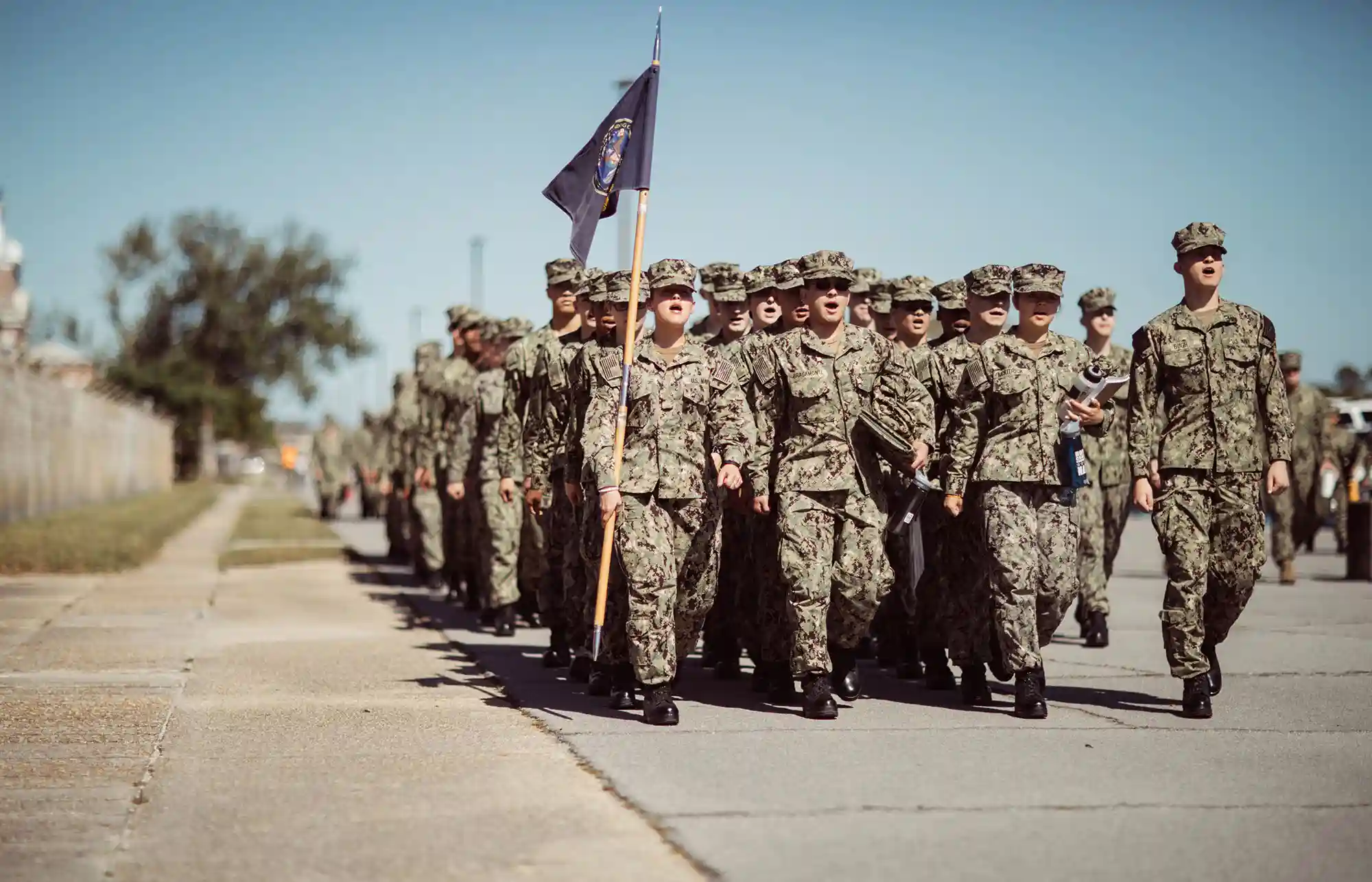
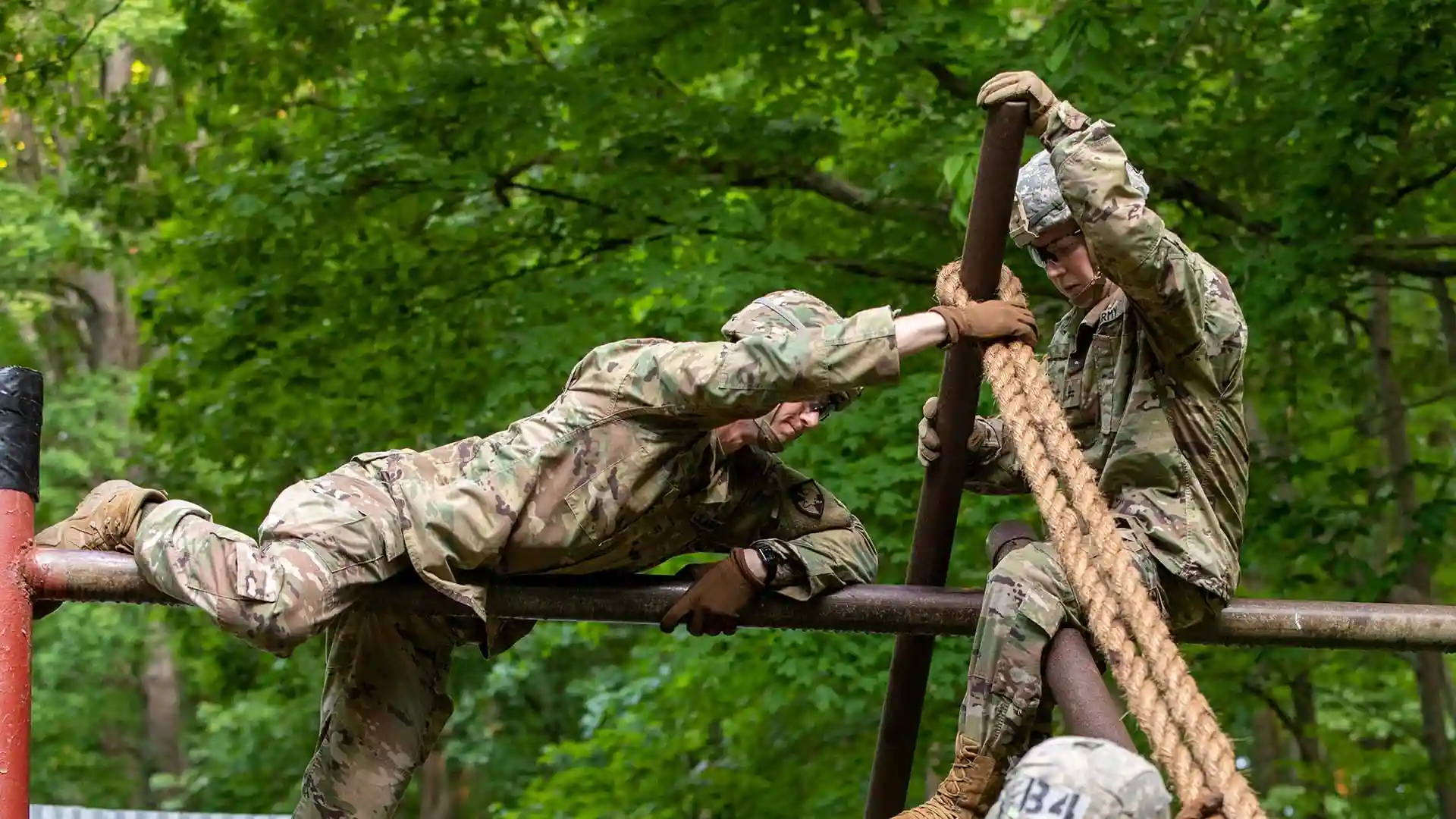
Army bootcamp, officially Basic Combat Training, runs ten weeks split into Reception, Red, White, and Blue phases. How long is army boot camp for someone entering a combat job like infantry? Longer, because those recruits move straight into advanced training under a system called OSUT, stretching the total timeline to 13 to 22 weeks depending on the specialty.
And that’s just one part of it. Physical fitness requirements climb alongside training length in most branches, though not perfectly. Navy and Coast Guard sit in the middle on both duration and intensity, which is part of why the Navy makes a useful detailed case study for the next section.
Navy Boot Camp Timeline And What To Expect
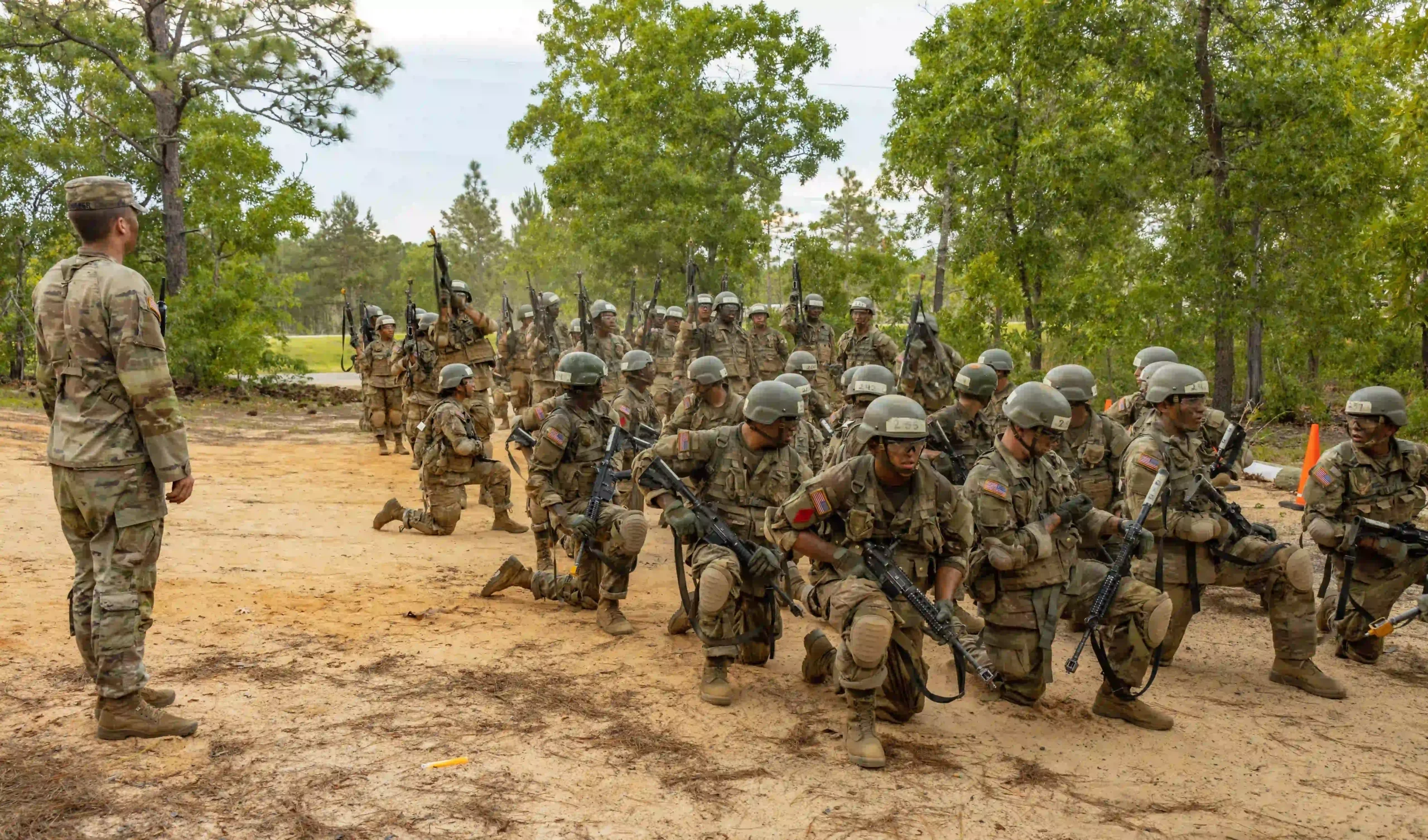
Navy boot camp, also known as Navy basic training, runs nine weeks at Recruit Training Command, Great Lakes, a length the Navy cut down from ten weeks starting in 2025. The navy boot camp schedule is built around a concept the Navy calls sailorization: turning a civilian into someone who can fight fires, control flooding, and stand watch aboard a ship, regardless of what job they’ll eventually hold.
Week 1: Navy Boot Camp Processing
The first days are Processing Days, or P-Days, covering medical screening, paperwork, and uniform issue. Recruits get a strictly timed 15-second phone call home to confirm safe arrival, and go through what the Navy calls the Moment of Truth, a formal review of anything in a recruit’s medical or legal history that wasn’t disclosed earlier. Week one also includes the Third Class Swim Qualification: a 50-yard swim, a five-minute prone float, and a clothing inflation drill.
Weeks 2-3: Military Training Basics
Here’s where it gets interesting. Navy training during these weeks covers basic seamanship, Navy history, and the Uniform Code of Military Justice, alongside continued physical conditioning. Recruits also start learning to live and operate as a division, the Navy’s term for their training unit, with a Recruit Division Commander overseeing daily life.
Weeks 4-6: Hands-On Recruit Skills
Navy training shifts toward firefighting and damage control during this stretch. Recruits learn the chemistry of shipboard fires, practice with breathing devices, and go through a confidence chamber. They also train in watertight integrity, basic pipe patching, and defense against chemical, biological, radiological, and nuclear threats, plus small arms familiarization with the 9mm handgun.
Weeks 7-8: Testing, Swim, And Battle Stations
The final stretch builds toward Battle Stations 21, a 12-hour overnight capstone aboard the USS Trayer, a full-scale destroyer simulator built inside a massive indoor facility at Great Lakes. Recruits work through 17 scenarios covering fires, flooding, and mass-casualty response, using everything they’ve learned over the previous seven weeks.
I’ve talked with enough people preparing for this stage to know the swim test worries them more than Battle Stations does, which is backward. Battle Stations is long and exhausting, but it’s a team event. The swim test, back in week one, is the part where a recruit is genuinely alone in the water.
“A rite of passage from recruit to Sailor.”
Chief Aviation Electronics Technician Tim McKinley, Battle Stations 21 training facilitator, Navy.mil
Pass Battle Stations, and a capping ceremony follows where the recruit’s “RECRUIT” ball cap gets traded for a “NAVY” one. Tens of thousands of recruits graduate from Recruit Training Command every year, all passing through this same final test.
Physical Requirements And Readiness Outcomes
Every branch requires recruits to pass a fitness test before graduation, and the specifics vary more than people expect. Army recruits take the five-event Army Fitness Test (deadlift, hand-release push-ups, sprint-drag-carry, plank, 2-mile run), while Marine Corps recruits face both a Physical Fitness Test and a separate Combat Fitness Test in full gear. Boot camp training, regardless of branch, treats the final fitness test as a hard gate, not a formality.
So what does that actually mean for you? It means showing up out of shape doesn’t disqualify anyone immediately, but it does mean weeks of catching up under pressure instead of building on a head start.
Navy Boot Camp Physical Requirements
Navy boot camp physical requirements come down to three events: forearm planks, push-ups, and a 1.5-mile run. Military OneSource confirms this is the current structure, with alternate cardio options like swimming available for some sailors after boot camp, though not typically during it. To graduate, a recruit needs an average score across the three events known as “Satisfactory Medium,” roughly a 50-point average out of 100.
For context, a male recruit aged 17 to 19 needs a 1:30 plank, 46 push-ups, and a 12:15 run on the 1.5 miles to hit that baseline. A female recruit in the same age bracket needs the same 1:30 plank, 20 push-ups, and a 14:45 run. Combat-specific training isn’t part of this fitness test; the boot camp PRT measures general fitness, with combat skills taught later at fleet schools.
- Forearm plank, held for time
- Push-ups, maximum reps in two minutes
- 1.5-mile timed run, or an approved alternate for some active-duty sailors
Military boot camp training pushes everyone toward the same minimum, but the bar moves with age and sex, which is intentional. The standard is meant to be achievable for a healthy recruit, not punishing for its own sake.
Daily Schedule, Living Conditions, And Training Gear
Think about it this way. Every hour of a recruit’s day is scheduled by someone else, for the entire length of training. The navy boot camp schedule, like every branch’s, runs 16 to 17 hours a day, starting around 0400 and ending with lights out between 2100 and 2200.
Reveille and hygiene kick off the day, followed by physical training before sunrise. Morning chow gets 10 to 15 minutes, not a leisurely breakfast. Classroom instruction, drill, and hands-on training fill the rest of the daylight hours, broken up by two more rushed meals.
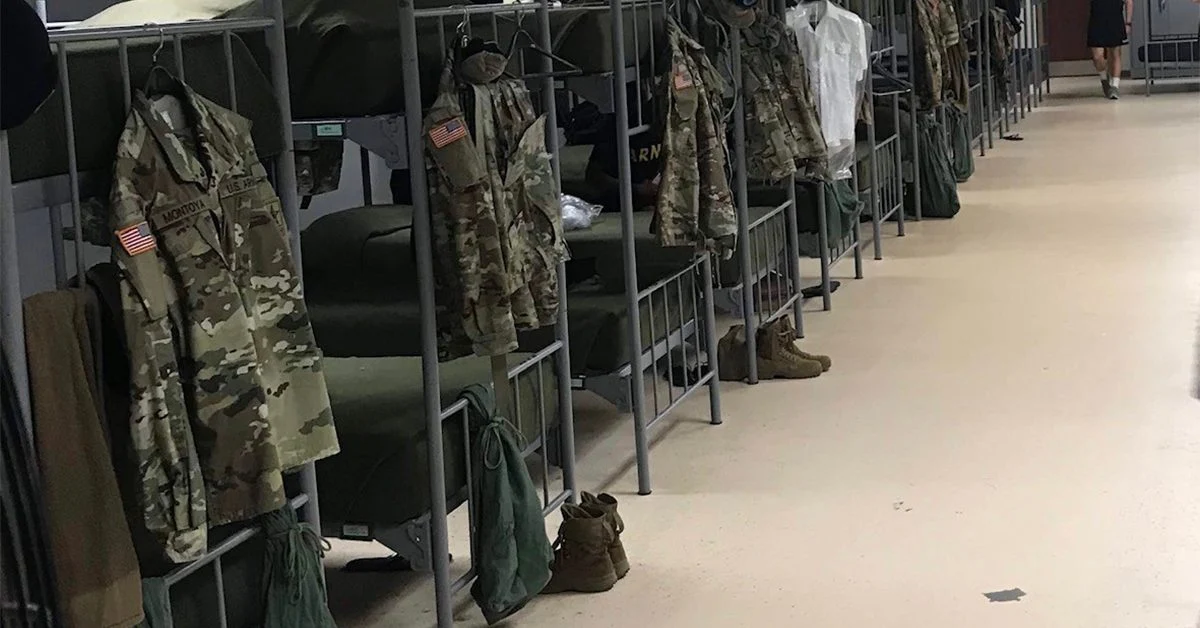
Military training equipment gets issued almost immediately, replacing whatever a recruit showed up wearing. Within the first days, personal clothing goes into storage and uniforms, boots, and field gear take over completely.
Typical Lights-Out Routine
Evening hours after dinner go to mail call, barracks cleaning, weapon maintenance, and uniform prep, followed by a short personal-time window for showers and letter writing. Lights out is mandatory, though recruits rotate through overnight fire-guard or watch duties that interrupt sleep on a schedule, not by accident.
The gear issued on day one matters less than the gym bag rule recruits are told about before they ever arrive: nearly every branch limits personal items to what fits in one small carry-on bag. Required documents include a state ID, an original Social Security card, and banking information for direct deposit. Everything else, food, supplements, vapes, and extra electronics, gets confiscated during the first shakedown, while military training equipment quickly fills the gap.
- State-issued photo ID
- Original Social Security card
- Banking or direct deposit information
- One to two days of plain civilian clothing for travel
Military boot camp training gear issued during the first week typically includes additional uniforms, hygiene items, and branch-specific equipment, but the personal items list stays minimal by design. There’s nowhere to store extra belongings, and nowhere private to use them anyway.
What Happens If You Don’t Meet Standards?
Recruits who fail a fitness test, miss a rifle qualification, or fail an academic exam don’t automatically wash out of boot camp training. The military uses a process called recycling, which moves a recruit out of their current group and into one that’s earlier in the training cycle, giving them more time on the specific skill they’re missing.
But there’s a catch. Recycling isn’t unlimited. A recruit who keeps failing the same standard after multiple attempts, or who can’t adapt to the discipline required, can eventually face administrative separation, usually an entry-level separation with uncharacterized service.
In my experience covering this topic for families considering enlistment, this is the part that worries parents most, more than the physical training itself.
Recycling exists specifically to prevent good candidates from washing out over a single bad week. It’s a second chance built into the system, not a punishment layered on top of it.
Injuries get handled differently than performance failures. A recruit with a significant injury typically moves to a medical rehabilitation unit, such as the Army’s Warrior Training Rehabilitation Program or the Marine Corps’ Medical Rehabilitation Platoon, recovers under medical supervision, then rejoins training.
Frequently Asked Questions
What is military boot camp?
What is boot camp, in plain terms? It’s the initial training program every branch requires before someone becomes a full member of the military. It mixes physical conditioning, classroom learning, and hands-on skills training, and every recruit goes through some version of it regardless of which job they’ll eventually hold. A boot camp graduate walks away able to follow orders under pressure, function with minimal sleep, and perform the basic tasks their branch requires on day one of their actual career.
How long is military boot camp?
It depends on the branch. Boot camp runs from 7.5 weeks for the Air Force and Space Force up to 13 weeks for the Marine Corps. Navy boot camp runs 9 weeks, Coast Guard runs 8, and Army boot camp runs 10. Combat-arms Army recruits who continue directly into job-specific training under OSUT can see their total time extend to 13 to 22 weeks.
How long is Army basic training?
How long is Army basic training? Ten weeks, for the standard Basic Combat Training pipeline every Army recruit completes regardless of job. Recruits who enlist into a combat job like infantry or armor train longer, because those recruits move directly into advanced training without a break, under the OSUT system. Their total time depends on the job, ranging from 13 weeks up to 22.
Where is boot camp located?
Boot camp locations are fixed by branch, not by where a recruit lives. Army recruits train at Fort Benning, Fort Jackson, Fort Leonard Wood, or Fort Sill. Marine Corps recruits go to Parris Island or San Diego. Navy recruits train exclusively at Great Lakes, Illinois, while Air Force and Space Force recruits share Joint Base San Antonio-Lackland in Texas, and Coast Guard recruits train at Cape May, New Jersey.
What happens if a recruit fails a test during boot camp?
Failing a single test rarely ends someone’s military career on the spot. Most failures trigger recycling, where a recruit gets folded into a group that’s earlier in the training cycle and given another shot at the specific standard they missed. Repeated failures, or an inability to meet the required discipline, can eventually lead to administrative separation. Injuries are handled separately through medical rehabilitation units rather than the standard recycling process.
Your Path to Enlistment
Choosing A Branch, Knowing What’s Ahead
The way I look at it, the branch comparison matters less than people think once training actually starts. Every program, whether it’s 7.5 weeks or 13, is built to be hard in the specific way that branch needs its people to be hard.
What changes is the flavor of the difficulty. Army and Marine Corps recruits spend more time on land navigation and weapons handling. Navy recruits spend more time on firefighting, flooding control, and water survival, since their entire career happens aboard ships where those skills matter daily, while Air Force, Space Force, and Coast Guard programs sit somewhere in between, shaped by their own missions.
If you’re weighing branches, our military training hub covers enlistment requirements, pay, and education benefits in more depth for each path. The right branch usually comes down to the job you want and the lifestyle you can picture yourself in for the next several years, not just how long boot camp lasts.

William Johnson writes about U.S. military training and enlistment for Servicemembers Opportunity Colleges. His work covers topics such as boot camp, ROTC, the ASVAB test, military pay, and what to expect during basic training, with a focus on giving recruits and their families clear, practical information about military life.
Sources
- Navy.com. “Boot Camp – What to Expect.” Navy.com, 2026.
- U.S. Navy. “Sailors Making Sailors: Battle Stations-21.” Navy.mil.
- Military OneSource. “Tips for Meeting Military Fitness Standards.” Military OneSource, 2026.
- Today’s Military. “Boot Camp.” Today’s Military, 2026.
- U.S. Department of Defense. “Suited to Serve.” Defense.gov.
- GoArmy.com. “Basic Combat Training.” GoArmy.com, 2026.
- Operation Military Kids. “Marine Corps PFT Standards Chart Updated For 2026.” OperationMilitaryKids.org, 2026.
- Military.com. “Coast Guard to Launch Service-Wide Physical Fitness Test for All Members Next Year.” Military.com, 2025.
- Marine Corps Recruit Depot Parris Island. “Unit Home.” MCRDPI.Marines.mil.