
US Navy ranks run across 24 pay grades in three tracks, but the sailors wearing them are spread very unevenly. As of July 31, 2026, the Navy had 348,294 active-duty sailors, and only 10 of them were four-star admirals, about 1 in 34,800. The most common rank in the fleet is E-5 Petty Officer Second Class, held by 72,619 sailors, or 20.9% of the Navy, according to Defense Manpower Data Center (DMDC) figures.
So, what are the ranks in the Navy? There are three ladders: enlisted (E-1 to E-9), warrant officer (W-1 to W-5) and commissioned officer (O-1 to O-10). The lowest is Seaman Recruit (E-1), and the highest active rank is Admiral (O-10), because no one has been appointed Fleet Admiral since 1945.
One more thing before the chart. For enlisted sailors, the Navy usually says “rate,” not “rank,” and that one word causes a lot of confusion.
Navy Ranks in Order, Lowest to Highest
Here are the U.S. Navy ranks lowest to highest, split into three tracks so the tables stay readable on a phone. Each row shows the pay grade, title, abbreviation and how many active-duty sailors held it on July 31, 2026.
Enlisted Ranks (E-1 to E-9)
| Pay grade | Rank | Abbreviation | Sailors (Jul 31, 2026) | Share of the Navy |
|---|---|---|---|---|
| E-1 | Seaman Recruit | SR | 11,254 | 3.23% |
| E-2 | Seaman Apprentice | SA | 22,598 | 6.49% |
| E-3 | Seaman | SN | 49,831 | 14.31% |
| E-4 | Petty Officer Third Class | PO3 | 50,005 | 14.36% |
| E-5 | Petty Officer Second Class | PO2 | 72,619 | 20.85% |
| E-6 | Petty Officer First Class | PO1 | 52,628 | 15.11% |
| E-7 | Chief Petty Officer | CPO | 22,259 | 6.39% |
| E-8 | Senior Chief Petty Officer | SCPO | 6,909 | 1.98% |
| E-9 | Master Chief Petty Officer | MCPO | 2,987 | 0.86% |
Warrant Officer Ranks (W-1 to W-5)
| Pay grade | Rank | Abbreviation | Sailors (Jul 31, 2026) | Share of the Navy |
|---|---|---|---|---|
| W-1 | Warrant Officer 1 | WO1 | 56 | 0.02% |
| W-2 | Chief Warrant Officer 2 | CWO2 | 798 | 0.23% |
| W-3 | Chief Warrant Officer 3 | CWO3 | 890 | 0.26% |
| W-4 | Chief Warrant Officer 4 | CWO4 | 442 | 0.13% |
| W-5 | Chief Warrant Officer 5 | CWO5 | 83 | 0.02% |
Officer Ranks (O-1 to O-10)
| Pay grade | Rank | Abbreviation | Sailors (Jul 31, 2026) | Share of the Navy |
|---|---|---|---|---|
| O-1 | Ensign | ENS | 7,726 | 2.22% |
| O-2 | Lieutenant Junior Grade | LTJG | 7,141 | 2.05% |
| O-3 | Lieutenant | LT | 19,702 | 5.66% |
| O-4 | Lieutenant Commander | LCDR | 10,314 | 2.96% |
| O-5 | Commander | CDR | 6,742 | 1.94% |
| O-6 | Captain | CAPT | 3,100 | 0.89% |
| O-7 | Rear Admiral (lower half) | RDML | 114 | 0.03% |
| O-8 | Rear Admiral (upper half) | RADM | 53 | 0.02% |
| O-9 | Vice Admiral | VADM | 30 | 0.01% |
| O-10 | Admiral | ADM | 10 | 0.003% |
Source: DMDC, active-duty strength as of July 31, 2026.
Read the columns together and a few things jump out. Half the Navy wears a petty officer’s crow, since E-4 through E-6 add up to 50.3% of all sailors. About 1 in 9 enlisted sailors is a chief, and the entire fleet has exactly 10 four-star admirals.
But here’s the thing. A title alone doesn’t show how rare a rank is or how hard it was to reach.
How Rare Is Each Navy Rank? The 2026 Numbers
Navy ranks get rare fast as you climb. The Navy has about 5.1 enlisted sailors for every officer, and every grade from E-9 or O-6 upward holds less than 1% of the force.
Petty officers in E-4 to E-6 make up 50.3% of the Navy. Chiefs (E-7 to E-9) are 11.05% of the enlisted force, or 9.2% of the whole Navy once officers are counted in the base.
Here’s what the data actually shows by tier.
| Group | Sailors | Share of the Navy | Roughly 1 in |
|---|---|---|---|
| Junior enlisted (E-1 to E-3) | 83,683 | 24.0% | 4 |
| Petty officers (E-4 to E-6) | 175,252 | 50.3% | 2 |
| Chiefs (E-7 to E-9) | 32,155 | 9.2% | 11 |
| Warrant officers (W-1 to W-5) | 2,269 | 0.65% | 154 |
| Junior officers (O-1 to O-3) | 34,569 | 9.9% | 10 |
| Mid-grade officers (O-4 to O-6) | 20,156 | 5.8% | 17 |
| Flag officers (O-7 to O-10) | 207 | 0.06% | 1,683 |
Source: DMDC, July 31, 2026; shares and ratios calculated from the DMDC counts.
How These Numbers Were Calculated
The figures come from the Defense Manpower Data Center report Active Duty Military Personnel by Rank/Grade, dated July 31, 2026. The Navy column was taken for all 24 pay grades: 57,201 officers (warrant officers included) plus 291,093 enlisted sailors, for a base of 348,294.
The 4,455 Naval Academy midshipmen are left out, and so are 3 records listed as “enlisted unknown grade.” Each share is the grade count divided by 348,294, and “1 in N” is 348,294 divided by the count. The numbers were checked on October 14, 2026.
Why Master Chiefs and Admirals Stay Rare
Part of the rarity is written into law. Section 517 of Title 10 caps E-9 at 1.25% and E-8 at 3.0% of the enlisted force, and in July 2026 the Navy sat at 1.03% and 2.37%.
Flag officers have caps too: the Navy’s own limit is 6 admirals and 150 flag officers under sections 525 and 526. Yet DMDC counts 10 admirals and 207 flag officers. That isn’t a violation, because officers serving in joint billets are counted separately under section 526(b).
What Do Navy Enlisted Ranks Actually Mean? (E-1 to E-9)
Navy enlisted ranks fall into three tiers, and each one carries a different kind of responsibility. Junior enlisted sailors (E-1 to E-3) are learning the trade, petty officers (E-4 to E-6) run the work, and chiefs (E-7 to E-9) run the people who run the work.
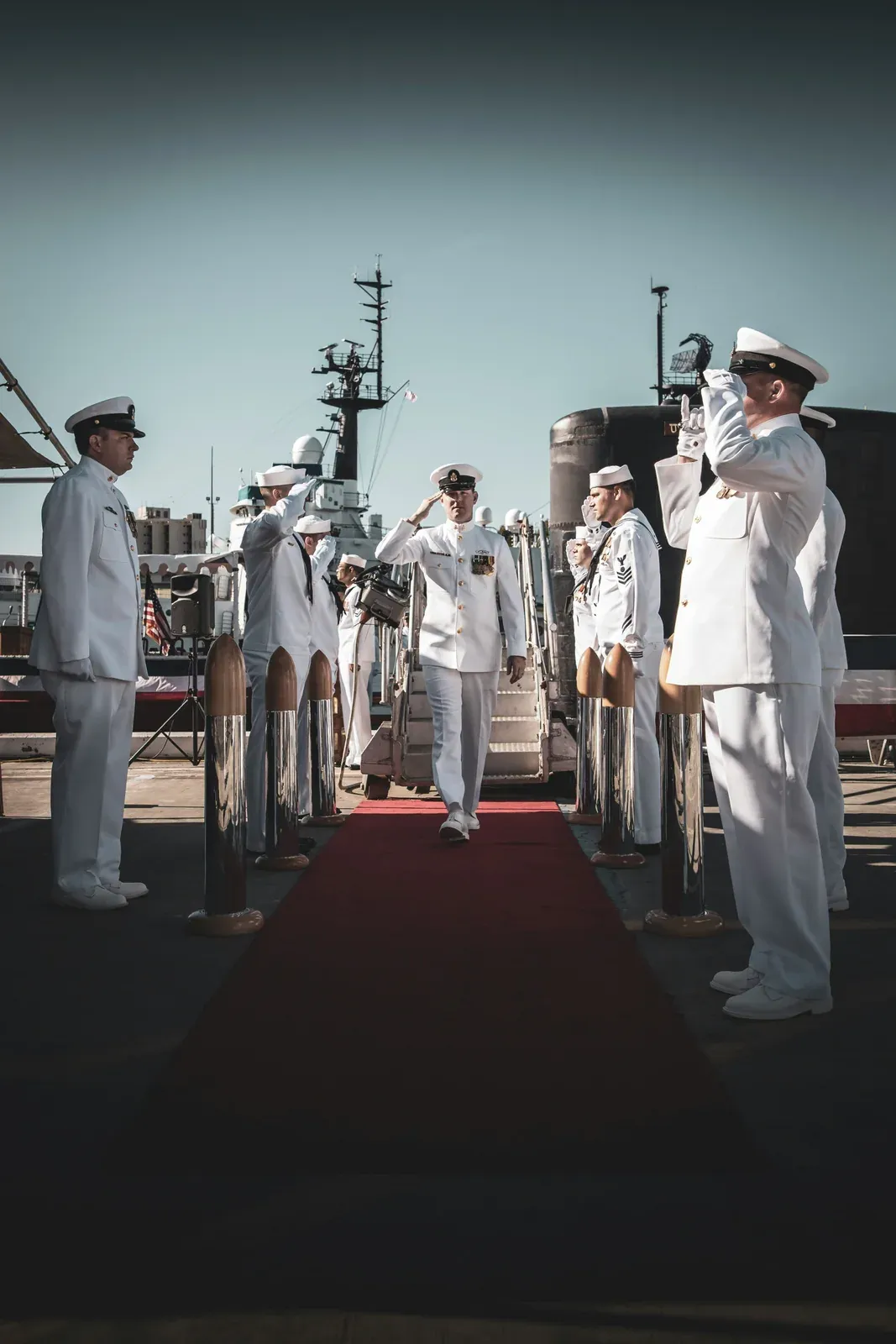
At the junior level, the title depends on the community a sailor belongs to. A rate code like AN or FN tells you both the community and the grade:
- Seaman: SR, SA, SN, for deck and general duties
- Fireman: FR, FA, FN, for engineering
- Airman: AR, AA, AN, for aviation
- Constructionman: CR, CA, CN, for the Seabees
- Hospitalman: HR, HA, HN, for medical work
Think about it this way. An E-3 is still learning the job, while an E-5 may already be supervising a small team or a watch station.
Petty officers are the Navy’s noncommissioned officers, and that status starts at Petty Officer Third Class (E-4).
The Chief Petty Officer Rank: E-7 to E-9
Making chief is a different kind of promotion. The chief petty officer rank isn’t won on an exam score alone: a selection board decides who advances, and new chiefs switch to khaki uniforms and join the chiefs’ mess.
Senior chief (E-8) and master chief (E-9) go through the same board process. Only 2,987 sailors held E-9 in July 2026, about 1 in 117 sailors in the whole Navy.
Some E-9 titles get mistaken for ranks. Command Master Chief, Fleet or Force Master Chief and the Master Chief Petty Officer of the Navy (MCPON) are positions held by master chiefs, not separate pay grades.
How the Navy Rank Structure Actually Works: Rank, Rate, Rating
The Navy rank structure uses four words that sound alike but mean different things. Pay grade is the pay level (E-5), rank is the title (Petty Officer Second Class), rating is the job (Gunner’s Mate), and rate is the rating plus the pay grade (GM2).
Here’s the part most people miss. Rate isn’t the job specialty; the rating is, and the rate simply stacks the grade on top of it.
The VA’s Navy rank abbreviation list follows this pattern: rating code first, grade suffix second.
| Code | Rating | Pay grade | Read as |
|---|---|---|---|
| GM2 | Gunner’s Mate | E-5 | Gunner’s Mate Second Class |
| HM3 | Hospital Corpsman | E-4 | Hospital Corpsman Third Class |
| AB1 | Aviation Boatswain’s Mate | E-6 | Aviation Boatswain’s Mate First Class |
| ABCS | Aviation Boatswain’s Mate | E-8 | Senior Chief Aviation Boatswain’s Mate |
| ABCM | Aviation Boatswain’s Mate | E-9 | Master Chief Aviation Boatswain’s Mate |
The suffix logic is simple once you see it. The numbers 3, 2 and 1 mean third, second and first class petty officer, while C, CS and CM mean chief, senior chief and master chief.
Officers don’t have rates at all, only ranks. And jobs like commanding officer (CO), executive officer (XO), command master chief (CMC) or division officer are billets, meaning positions a sailor fills, not ranks. Rank decides who can hold a billet, and billets form the chain of command.
What Happened to the Navy Warrant Officer Ranks?
The Navy warrant officer ranks still exist, but the entry point just moved. Warrant officers are technical specialists drawn from the enlisted ranks; a WO1 serves under a warrant, while CWO2 and above are commissioned.
The Navy brought WO1 back in 2018 for cyber sailors, with the first selectees announced in NAVADMIN 293/18, according to MOAA reporting. Michael Otten of BUPERS Community Management explained the goal:
“The addition of this rank allows specific sailors a path to become an officer.” (quoted by MOAA, 2019)
But there’s a catch. Under NAVADMIN 161/25, no new WO1s are selected from FY2027 on, and cyber entry goes back to CWO2. Yet 56 WO1s were still serving on July 31, 2026, so the rank is closed to newcomers but not gone.
Navy Officer Ranks: From Ensign to Admiral
Navy officer ranks run from Ensign (O-1) to Admiral (O-10). Sources group them differently; this guide uses junior (O-1 to O-3), mid-grade (O-4 to O-6) and flag officers (O-7 to O-10).
Ensign is the usual entry rank for new officers. Most arrive through the Naval Academy at Annapolis, NROTC or Officer Candidate School, and sailors already in uniform can follow the enlisted-to-officer commissioning path.
Junior officers lead divisions, mid-grade officers run departments and commands, and captains (O-6) command the largest ships.
Navy Admiral Ranks and the Fleet Admiral Question
The Navy admiral ranks climb from one star to four: Rear Admiral lower half (RDML, O-7), Rear Admiral upper half (RADM, O-8), Vice Admiral (VADM, O-9) and Admiral (ADM, O-10). That makes Admiral the highest rank in Navy service today.
Here’s where it gets interesting. Congress created a five-star grade, Fleet Admiral, by an act approved on December 14, 1944, per the Naval Historical Foundation. Leahy, King and Nimitz received it in December 1944, and Halsey became “the fourth and last” on December 11, 1945.
The grade is inactive. Charts that list an “O-11” grade are using shorthand, because O-11 is not an official pay grade.
Same Word, Different Grade
Navy officer titles trip up anyone used to the Army, Marine Corps or Air Force. A Navy captain outranks an Army captain by three pay grades.
| Navy title | Navy pay grade | Same pay grade in the Army, USMC, USAF |
|---|---|---|
| Captain | O-6 | Colonel (their Captain is O-3) |
| Lieutenant | O-3 | Captain |
| Lieutenant Commander | O-4 | Major |
| Commander | O-5 | Lieutenant Colonel |
| Chief Petty Officer | E-7 | E-7 (a senior NCO in every branch) |
The rule is short: confirm the pay grade, not the word. The Space Force ranks guide shows the same trap in the newest branch, and the enlisted vs officer breakdown explains how the two tracks differ.
How to Read Navy Rank Insignia
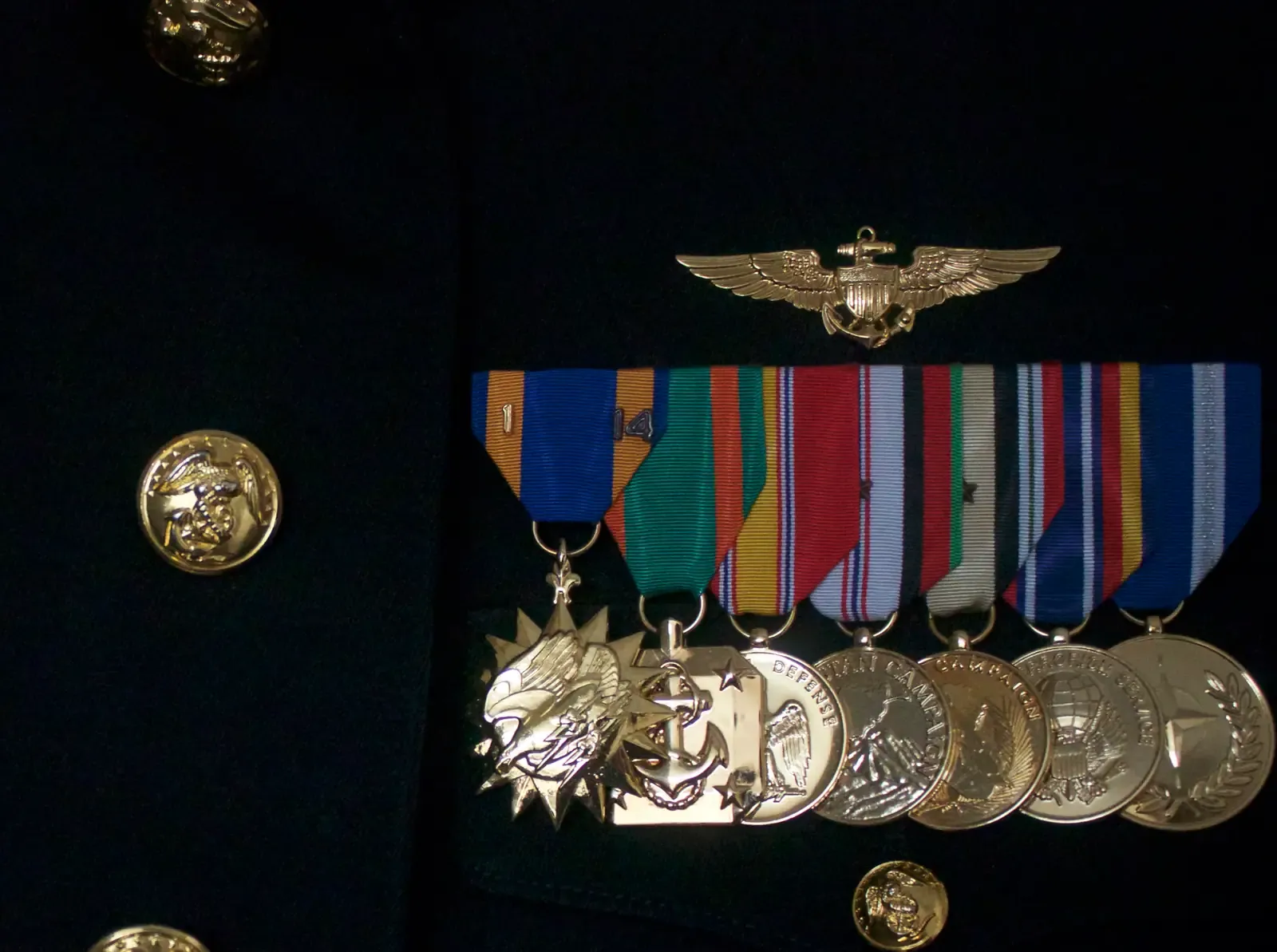
Navy rank insignia change with the uniform. The official military insignia chart explains the split: collar devices on khakis, shoulder boards with whites and stripes on the lower sleeve with dress blues.
| Rank group | Khakis (collar) | Whites (shoulder boards) | Dress blues (sleeves) |
|---|---|---|---|
| Junior officers (O-1 to O-3) | Gold or silver bars | Gold stripes | Gold stripes |
| Mid-grade officers (O-4 to O-6) | Oak leaf (O-4, O-5) or eagle (O-6) | More gold stripes | More gold stripes |
| Flag officers (O-7 to O-10) | One to four silver stars | Stars on gold boards | One broad gold stripe (O-7), plus one to three narrower stripes (O-8 to O-10) |
Enlisted insignia follow a simpler logic:
- E-1: no rank device at all.
- E-2 and E-3: two or three diagonal stripes, colored by community (white for Seaman, red for Fireman, green for Airman).
- E-4 to E-6: one to three chevrons under an eagle, which sailors call the “crow,” with the rating mark between them.
- E-7: the chevrons gain an arc on top, called a rocker, and khakis carry a fouled anchor on the collar.
- E-8 and E-9: one or two stars added above the eagle.
Chevrons switch from red to gold after 12 or more years of good conduct, so a PO1 with red chevrons and a PO1 with gold ones hold exactly the same grade.
How Do Promotions Work in the Navy?
Navy promotions run on different systems depending on where a sailor sits. The first steps are close to automatic, the middle steps depend on exams or billets, and the top enlisted and officer ranks go through selection boards.
- E-1 to E-2 after 9 months of service, E-3 at 18 months and E-4 at 30 months, with only the commanding officer’s recommendation needed.
- E-5 and E-6 through advancement exams, Command Advance to Position (CA2P) or Billet Based Advancement.
- E-7 to E-9 through annual selection boards, with time-in-rate and time-in-service minimums.
- Officers through promotion boards, after a minimum time in grade set by federal law.
The automatic steps to E-4 came from Navy message NAVADMIN 168/23, announced in July 2023 and effective July 1, 2024. Nuclear, advanced technical and advanced electronics fields, plus PACT sailors, follow separate rules.
For E-5 and E-6, the exam is shrinking as a path. The March 2026 cycle (Cycle 271) had only 1,100 exam quotas for E-6 against 72,619 E-5s, and 14 ratings, including Gunner’s Mate, now advance fully through Billet Based Advancement.
Officer timing is set by law in section 619 of Title 10. An ensign needs at least 18 months in grade before promotion to LTJG, and an LTJG needs 24 months. Lieutenants, lieutenant commanders and commanders need three years in grade before a board can consider them, and captains need one year.
So what does that actually mean for you? The odds change sharply from one step to the next.
| Step | FY2027 numbers | What it means |
|---|---|---|
| Lieutenant to LCDR (O-4) | 1,226 of 1,530 in zone (80.1%) | Most make it |
| LCDR to Commander (O-5) | 464 of 555 in zone (83.6%) | Most make it |
| Commander to Captain (O-6) | 241 of 384 in zone (62.8%) | A real cut |
| E-6 to Chief (E-7) | 3,666 quota | About 7 per 100 E-6s |
| E-7 to Senior Chief (E-8) | 1,653 quota | About 7 per 100 E-7s |
| E-8 to Master Chief (E-9) | 539 quota | About 8 per 100 E-8s |
Source: MyNavyHR FY27 Unrestricted Line board statistics and FY27 chief quotas; ratios use DMDC counts from July 31, 2026.
For the chief petty officer rank, these ratios count all sailors in the grade below, not only the eligible ones, so a qualified candidate’s real odds are better. On the officer side, above-zone selection ran about 15 to 18%, and below-zone under 5%.
Two practical notes for recruits. JROTC and college credit can qualify recruits for an advanced paygrade at enlistment, so confirm the current rules with a recruiter. Basic pay rose 3.8% on January 1, 2026.
At the very top, pay flattens. In 2026, basic pay for O-7 to O-10 is capped at $18,999.90 a month by the Executive Schedule Level II limit, so a four-star admiral and a two-star with enough service draw the same basic pay. The $18,808.20 figure still quoted online was the 2025 cap.
Frequently Asked Questions
How many ranks are in the Navy?
On paper, the Navy has 24 pay grades: nine enlisted, five warrant and ten officer. Count the inactive Fleet Admiral and you get 25. Since no new WO1s are selected from FY2027, which began October 1, 2026, only 23 grades are open to new appointments. Even so, 56 WO1s were still serving as of July 31, 2026.
What is the highest rank in the Navy?
The highest rank in Navy service today is Admiral, pay grade O-10, with four stars. As of July 31, 2026, 10 officers held it. Fleet Admiral sits above it on paper, but only four officers ever held that five-star grade, all during World War II. Any chart showing “O-11” is using an unofficial label.
What is the lowest rank in the Navy?
For enlisted sailors, the lowest rank is Seaman Recruit (E-1). On the warrant side, WO1 is the lowest grade, but it’s closed to new selections, so new warrant officers now start at CWO2. For commissioned officers, the starting rank is Ensign (O-1). Most recruits begin at E-1, though some qualify for a higher entry grade.
Is admiral higher than commander?
Yes, by a wide margin. Commander is pay grade O-5, while the lowest admiral rank, Rear Admiral lower half, is O-7. Captain (O-6) sits between them. Don’t confuse the Navy rank of Commander with “commander” as a job title: Commander, U.S. Pacific Fleet, for example, is a four-star admiral’s billet.
What is an ensign in the Navy?
An ensign is the Navy’s entry-level commissioned officer, pay grade O-1, abbreviated ENS. Federal law requires at least 18 months as an ensign before promotion to lieutenant junior grade. As of July 31, 2026, the Navy had 7,726 ensigns. That works out to roughly 773 ensigns for every four-star admiral.
How many admirals does the Navy have?
As of July 31, 2026, the Navy had 10 four-star admirals and 207 flag officers in total. That’s about one flag officer for every 1,683 sailors. The law caps the Navy at 6 admirals and 150 flag officers, but officers in joint billets are counted separately. So the higher count is not a breach of the cap.
Where This Leaves You
For most sailors, navy ranks are a story about the middle of the pyramid. Petty Officer Second Class is the most common rank in the fleet.
So why does this matter? Making chief is a genuine milestone, with roughly 7 new chiefs for every 100 first class petty officers each year, and flag rank belongs to about two hundred people.
When a rank title comes up, check the pay grade first. It’s the one detail that keeps its meaning across every branch.
Sources
- Defense Manpower Data Center. “Active Duty Military Personnel by Rank/Grade,” July 31, 2026.
- MyNavyHR. “NAVADMIN 168/23: Navy-Wide Apprentice (E1-E4) Advancement Changes,” 2023.
- MyNavyHR. “FY27 Active-Duty Officer Promotion Board Statistics (Lieutenant Commander, Line),” 2026.
- U.S. Department of War. “U.S. Military Rank Insignia.”
- Legal Information Institute, Cornell Law School. “10 U.S. Code § 619: Eligibility for Consideration for Promotion.”
- Naval Historical Foundation. “Fleet Admirals, US Navy,” 1966.