
The US Space Force has nine enlisted ranks (Specialist 1 through Chief Master Sergeant) and ten officer ranks (Second Lieutenant through General), plus the Chief Master Sergeant of the Space Force, a billet currently held by John F. Bentivegna. Rank names became official on February 1, 2021, and insignia followed later that year. Pay matches every other branch at the same grade and years of service.
If you’ve spent any time researching US Space Force ranks, the first thing that probably threw you off is the word “Specialist.” Every other branch calls its newest members airmen, privates, or seamen. The Space Force doesn’t. Its junior enlisted troops are Specialists, ranked 1 through 4, and that choice was deliberate.
That’s just the start. Space force ranks run nine enlisted grades and ten officer grades, plus one special position at the very top of the enlisted ladder. The pay is identical to every other branch at the same grade and years of service.
What’s different is the name, the insignia, and the story behind both. This guide walks through the full rank ladder, what the insignia actually mean, and what Guardians earn in 2026.
In This Article
- What Are the Space Force Ranks, in Order?
- What Are the Space Force Enlisted Ranks?
- What Are the Space Force Officer Ranks?
- Who Is the Chief Master Sergeant of the Space Force?
- What Does Space Force Insignia Look Like, and What Does It Mean?
- How Are Space Force Ranks Worn on the Uniform?
- How Much Do Space Force Guardians Get Paid by Rank?
- Why Did the Space Force Choose These Rank Names?
- Frequently Asked Questions
- Where This Leaves You
What Are the Space Force Ranks, in Order?
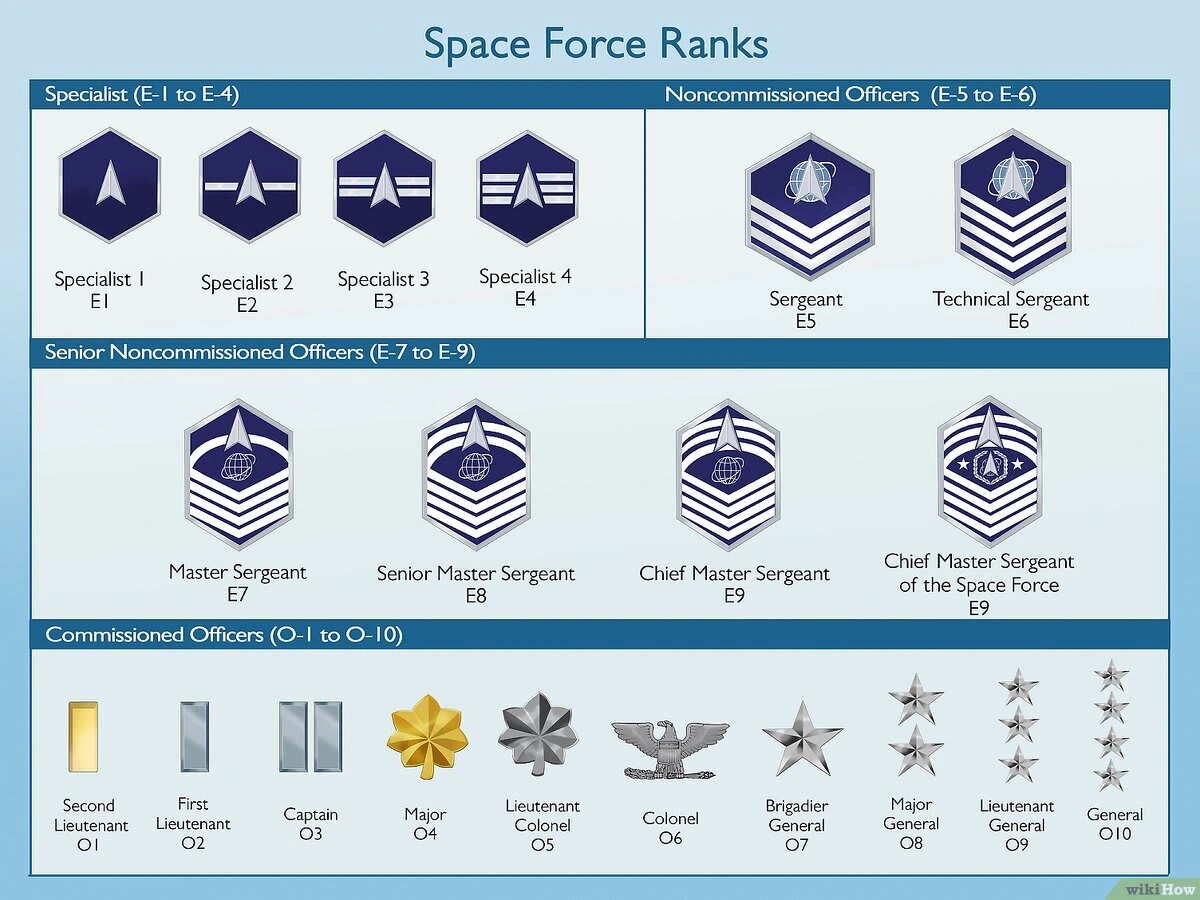
Space force ranks in order, from lowest to highest, run like this on the enlisted side: Specialist 1, Specialist 2, Specialist 3, Specialist 4, Sergeant, Technical Sergeant, Master Sergeant, Senior Master Sergeant, and Chief Master Sergeant. Officers start at Second Lieutenant and climb through First Lieutenant, Captain, Major, Lieutenant Colonel, Colonel, Brigadier General, Major General, Lieutenant General, and General.
One position sits outside that ladder entirely: Chief Master Sergeant of the Space Force. It’s a billet, not a pay grade. The person holding it is still technically an E-9, but they serve as the top enlisted advisor for the whole service.
Here’s the part most people miss. A space force rank tells you almost nothing about pay by itself. Pay is set by pay grade and years of service, and pay grade is shared across all six branches.
The rank name is just the label the Space Force chose to put on that grade.
What Are the Space Force Enlisted Ranks?
Space force enlisted ranks split into three tiers. Junior enlisted Specialists cover E-1 through E-4. Non-commissioned officers, known as NCOs, hold E-5 and E-6.
Senior NCOs run E-7 through E-9.
The Specialist tier is the biggest departure from tradition. When ussf enlisted ranks were finalized on February 1, 2021, Specialist 1 replaced Airman Basic, Specialist 2 replaced Airman, Specialist 3 replaced Airman First Class, and Specialist 4 replaced Senior Airman. Above that, the Space Force kept the sergeant names it inherited from the Air Force.
| Pay Grade | Rank | Abbreviation | Tier |
|---|---|---|---|
| E-1 | Specialist 1 | Spc1 | Junior enlisted |
| E-2 | Specialist 2 | Spc2 | Junior enlisted |
| E-3 | Specialist 3 | Spc3 | Junior enlisted |
| E-4 | Specialist 4 | Spc4 | Junior enlisted |
| E-5 | Sergeant | Sgt | NCO |
| E-6 | Technical Sergeant | TSgt | NCO |
| E-7 | Master Sergeant | MSgt | Senior NCO |
| E-8 | Senior Master Sergeant | SMSgt | Senior NCO |
| E-9 | Chief Master Sergeant | CMSgt | Senior NCO |
Think about it this way. Sergeant and up sound almost identical to Air Force ranks, and that’s not an accident. The Space Force grew directly out of the Department of the Air Force, and it kept the sergeant tier rather than inventing something new.
So the enlisted ranks Guardians hold today are really a mix of a brand-new junior tier and a borrowed senior tier.
What Are the Space Force Officer Ranks?
Space force officer ranks mirror the Air Force and Army almost exactly. Second Lieutenant and First Lieutenant make up the newest officers. Captain completes the company-grade ranks, and Major, Lieutenant Colonel, and Colonel cover the field-grade years.
Brigadier General through General round out the general officer tier.
Space Force officer ranks divide into three groups: company grade (O-1 to O-3), field grade (O-4 to O-6), and general officer (O-7 to O-10). The most senior Guardian in uniform is the Chief of Space Operations, a four-star General who sits on the Joint Chiefs of Staff. As of September 2026, that’s General Douglas Schiess, who took over from General B. Chance Saltzman.
| Pay Grade | Rank | Abbreviation | Tier |
|---|---|---|---|
| O-1 | Second Lieutenant | 2d Lt | Company grade |
| O-2 | First Lieutenant | 1st Lt | Company grade |
| O-3 | Captain | Capt | Company grade |
| O-4 | Major | Maj | Field grade |
| O-5 | Lieutenant Colonel | Lt Col | Field grade |
| O-6 | Colonel | Col | Field grade |
| O-7 | Brigadier General | Brig Gen | General officer |
| O-8 | Major General | Maj Gen | General officer |
| O-9 | Lieutenant General | Lt Gen | General officer |
| O-10 | General | Gen | General officer |
The officer corps is small compared to the other branches, numbering in the low thousands, and it’s concentrated heavily in the Space Operations career field. So most of the officers running satellites, radar, and missile-warning systems hold one of these ten grades.
Who Is the Chief Master Sergeant of the Space Force?
The current Chief Master Sergeant of the Space Force is John F. Bentivegna, who took over the role on September 15, 2023. He’s the second person to hold it, following Roger A. Towberman, the service’s first senior enlisted leader.
Bentivegna spent decades in Air Force and Space Force operations before stepping into the job. Now he serves as the senior enlisted advisor to the Chief of Space Operations and the Secretary of the Air Force on everything touching the welfare, readiness, and development of the enlisted force.
The position comes with a flat pay rate. Under the 2026 basic pay tables, the Chief Master Sergeant of the Space Force earns $11,166.90 a month regardless of years of service, the same rate paid to the top enlisted leader of every other branch.
That flat rate isn’t unique to this job, either. It applies to a short list of senior enlisted positions across the entire Department of Defense.
In my years covering military pay for families researching enlistment, that’s the kind of detail that gets lost in generic pay charts.
What Does Space Force Insignia Look Like, and What Does It Mean?
Space force insignia breaks from the horizontal stripe tradition every other branch uses. Every enlisted design sits on a hexagon, representing the Space Force as the sixth branch of the armed forces, with the delta symbol at the center.
The progression tells a visual story as a Guardian climbs the ranks:
- Specialist 1: no rank insignia
- Specialist 2 through 4: one horizontal “Vandenberg Stripe” added per grade
- Sergeant: those stripes bend into upward chevrons, and a Delta, Globe and Orbit design gets added beneath
- Technical Sergeant: a fourth chevron joins the design
- Master Sergeant through Chief Master Sergeant: the delta rises above the globe onto arcing orbital chevrons, one arc per grade, tracking Low, Medium, and Geosynchronous Earth orbit
The Space Force’s own design materials describe the insignia as a visual story: the Delta rising above the Globe marks growing responsibility, and the Delta breaking through the orbit rings represents a Guardian’s willingness to explore and innovate.
U.S. Space Force enlisted rank insignia information sheet, as reported by Air Force Times, 2021
So what does that actually mean for you? If you ever need to read a Guardian’s rank at a glance, count the chevrons and check whether the delta sits above or below the globe. Space force rank insignia also carries a simpler story on the officer side: officers use the same stars, eagles, and oak leaves the Air Force always has, just with Space Force delta buttons introduced in 2022.

How Are Space Force Ranks Worn on the Uniform?
On the service dress uniform, metal rank insignia sits on the shoulder straps, the same spot officers and senior NCOs have worn rank for generations.
Space force uniforms and ranks work differently on the OCP, the Space Force’s combat utility uniform. There, embroidered navy blue rank insignia gets sewn onto a patch worn on the center of the chest instead of the shoulder or collar.
That center-chest placement isn’t unique, since the Army and Air Force wear rank the same way on their OCPs. What sets the Space Force apart is the navy blue embroidered insignia.

How Much Do Space Force Guardians Get Paid by Rank?
The short answer? It depends. Grade and years of service decide the number, not which branch you’re in.
A Space Force Sergeant, an Army Sergeant, and a Navy Petty Officer Second Class at the same pay grade and the same years in uniform earn the exact same base pay.
Under the 2026 DFAS enlisted pay tables, base pay for Space Force ranks runs from $2,407 a month for a Specialist 1 up to roughly $7,496 a month for a Chief Master Sergeant with 16 years in. The table below shows where each grade lands at three career points.
| Pay Grade | Rank | Entry (<2 yrs) | Over 8 yrs | Over 16 yrs |
|---|---|---|---|---|
| E-1 | Specialist 1 | $2,407 | $2,407 | $2,407 |
| E-2 | Specialist 2 | $2,698 | $2,698 | $2,698 |
| E-3 | Specialist 3 | $2,837 | $3,198 | $3,198 |
| E-4 | Specialist 4 | $3,142 | $3,815 | $3,815 |
| E-5 | Sergeant | $3,343 | $4,300 | $4,422 |
| E-6 | Technical Sergeant | $3,401 | $4,613 | $5,194 |
| E-7 | Master Sergeant | $3,932 | $5,136 | $6,001 |
| E-8 | Senior Master Sergeant | — | $5,657 | $6,448 |
| E-9 | Chief Master Sergeant | — | — | $7,496 |
| E-9 (special) | Chief Master Sgt of the Space Force | $11,167 flat | $11,167 flat | $11,167 flat |
| O-1 | Second Lieutenant | $4,150 | $5,222 | $5,222 |
| O-2 | First Lieutenant | $4,782 | $6,618 | $6,618 |
| O-3 | Captain | $5,534 | $8,126 | $9,004 |
| O-4 | Major | $6,295 | $8,816 | $10,402 |
| O-5 | Lieutenant Colonel | $7,295 | $9,461 | $11,391 |
| O-6 | Colonel | $8,751 | $10,725 | $13,115 |
On the general officer side, 2026 basic pay for commissioned officers climbs well past Colonel. O-7 through O-10 follow a different scale entirely, rising with years of service up to a legal ceiling of $18,999.90 a month, the same cap that applies to four-star officers across every branch.
U.S. Space Force ranks also come with tax-free housing and subsistence allowances on top of base pay, which usually add a meaningful chunk to total compensation. Those allowances vary by location and dependency status, so they aren’t reflected in the table above.
Why Did the Space Force Choose These Rank Names?
The Space Force almost didn’t get to choose its rank names at all.
In mid-2020, a provision in the House version of the National Defense Authorization Act would have forced the service to adopt Navy-style ranks and grades. The Senate disagreed, and the final law dropped the requirement entirely.
- September 1, 2020: 2,410 Air Force enlisted members transfer into the Space Force, keeping their Air Force ranks for the time being
- January 29, 2021: the Space Force announces its own service-specific rank names, effective February 1, 2021
- September 20 to 21, 2021: the enlisted rank insignia designs are unveiled, completed under Chief Master Sergeant Roger Towberman
- December 2023: Congress permanently sets the officer rank titles to match the Army, Marine Corps, and Air Force
And that’s just one part of it. After years of writing about enlistment and military training for families weighing which branch to join, I’ve noticed the “Specialist” choice comes up in almost every conversation about the Space Force. It’s the one rank name that doesn’t sound like it was borrowed from anywhere else, and that was the point.
Frequently Asked Questions
What are the Space Force enlisted ranks, from lowest to highest?
Space Force enlisted ranks run from Specialist 1 up through Chief Master Sergeant. The order is Specialist 1, Specialist 2, Specialist 3, Specialist 4, Sergeant, Technical Sergeant, Master Sergeant, Senior Master Sergeant, and Chief Master Sergeant. The four Specialist grades cover junior enlisted troops, while Sergeant and Technical Sergeant make up the NCO tier. Master Sergeant and above are senior NCOs, capped by the Chief Master Sergeant of the Space Force at the very top.
Does the Space Force have warrant officers?
No. The Space Force has no warrant officer ranks and relies on its enlisted and commissioned officer ladders instead. When the Air Force revived warrant officers for cyber and IT roles in 2024, Space Force leaders said the service had no plans to follow.
Why does the Space Force use “Specialist” instead of “Airman” or “Private”?
The Space Force wanted a name that signaled technical skill from day one, not just entry-level status. Every other branch’s junior enlisted title, whether airman, private, or seaman, describes someone new to the service. Specialist was meant to reflect that even brand-new Guardians are trained to run satellites, radar, and cyber systems. The name became official on February 1, 2021, when it replaced the Air Force airman ranks the first Guardians had transferred in with.
Who is the current Chief of Space Operations?
As of September 2026, the Chief of Space Operations is General Douglas Schiess, confirmed by the Senate in August 2026 and installed after General B. Chance Saltzman’s retirement. It’s the Space Force’s most senior officer role, a four-star General who sits on the Joint Chiefs of Staff. Before taking the position, Schiess served as deputy Chief of Space Operations, overseeing the service’s global operations and readiness. Because assignments like this rotate every few years, it’s worth checking the Space Force’s official leadership page for the latest name.
Where This Leaves You
Space force ranks look confusing for about five minutes, and then the pattern clicks. Junior enlisted Guardians are Specialists 1 through 4. NCOs and senior NCOs keep the sergeant names borrowed from the Air Force.
Officers run Second Lieutenant through General, same as the Army and Air Force always have.
The insignia tell the same story visually: a hexagon for the sixth branch, a delta at the center, and a rising set of orbital chevrons that track a Guardian’s climb from Earth toward geosynchronous orbit. None of it changes what’s in a Guardian’s paycheck. Pay follows grade and years of service, full stop, regardless of what the rank is called.
If you’re weighing whether the Space Force is the right fit, the rank structure itself probably won’t be the deciding factor. What matters more is the career field, the mission, and whether the idea of running satellites and space systems sounds like the kind of work you want to do for the next several years.

William Johnson writes about U.S. military training and enlistment for Servicemembers Opportunity Colleges. His work covers topics such as boot camp, ROTC, the ASVAB test, military pay, and what to expect during basic training, with a focus on giving recruits and their families clear, practical information about military life.
Sources
- Defense Finance and Accounting Service. “Basic Pay: Enlisted.” DFAS, 2026.
- Defense Finance and Accounting Service. “Basic Pay: Officers.” DFAS, 2026.
- Wikipedia. “John F. Bentivegna.” 2026.
- Wikipedia. “Chief of Space Operations.” 2026.
- Secretary of the Air Force Public Affairs. “Space Force Releases Service-Specific Rank Names.” Space Force, 2021.