

West Point’s candidate fitness assessment is a six-event physical test that counts for 15% of your application. It measures explosive power, upper-body strength, core endurance, agility, and aerobic capacity. West Point doesn’t publish a minimum score, but competitive data gives you a working target. This guide covers how each event is scored, what the maximums mean, and how the CFA works across all three service academies.
If you’ve been searching for the West Point candidate fitness assessment minimum score, you’ve probably noticed something strange: the number isn’t public. West Point doesn’t publish a minimum, so the practical target is a competitive score rather than a floor, and that changes how you have to think about your prep.
The West Point Candidate Fitness Assessment, also called the USMA CFA, is a scored six-event test measuring physical aptitude for military service. Your score goes directly into your admissions package as a competitive number that either helps or hurts you against every other candidate in your cycle.
In This Article
- What Is the Candidate Fitness Assessment?
- What Are the Six CFA Events, and How Are They Scored?
- West Point CFA Scores: What the Maximums Really Mean
- Is There a Minimum Passing Score for the West Point CFA?
- How the CFA Differs at West Point, the Air Force Academy, and the Naval Academy
- Why Do Men’s and Women’s CFA Standards Differ?
- Is the West Point CFA the Same as the Army Fitness Test (AFT)?
- Frequently Asked Questions
- Where This Leaves Your CFA Prep
What Is the Candidate Fitness Assessment?
The candidate fitness assessment is a standardized six-event physical test used by all three federal service academies to evaluate whether applicants have the physical aptitude for military training. It covers explosive power, muscular endurance, agility, and cardiovascular capacity. Each event produces a raw score that gets converted to a 0-to-100 scale, and your total across all six events feeds directly into your admissions package.
This test isn’t designed like the fitness benchmarks most high school athletes are used to. It’s not pass/fail in the traditional sense, and it’s not measuring whether you can survive basic training. The cfa military test is built to predict long-term physical performance as a cadet and officer, and that distinction changes how you need to train for it.
In my experience covering military admissions, candidates consistently underestimate this test. They train for the events in isolation without understanding how the scoring works or what the competitive field actually looks like. By the time they realize the CFA is a differentiator and not just a hurdle, they’ve already submitted a number they can’t take back.
At West Point, the CFA counts for about 15% of your application score, according to West Point. That’s a meaningful slice of a competitive package. Strong academics and extracurriculars won’t carry a weak CFA if you’re competing against candidates who performed well across all six events.
What Are the Six CFA Events, and How Are They Scored?
The CFA consists of exactly six events, administered in a set order. Each event is scored on a 0-to-100 scale, where 100 represents the maximum performance benchmark. Your composite score is the average across all six events, which means no single event carries more weight than another.
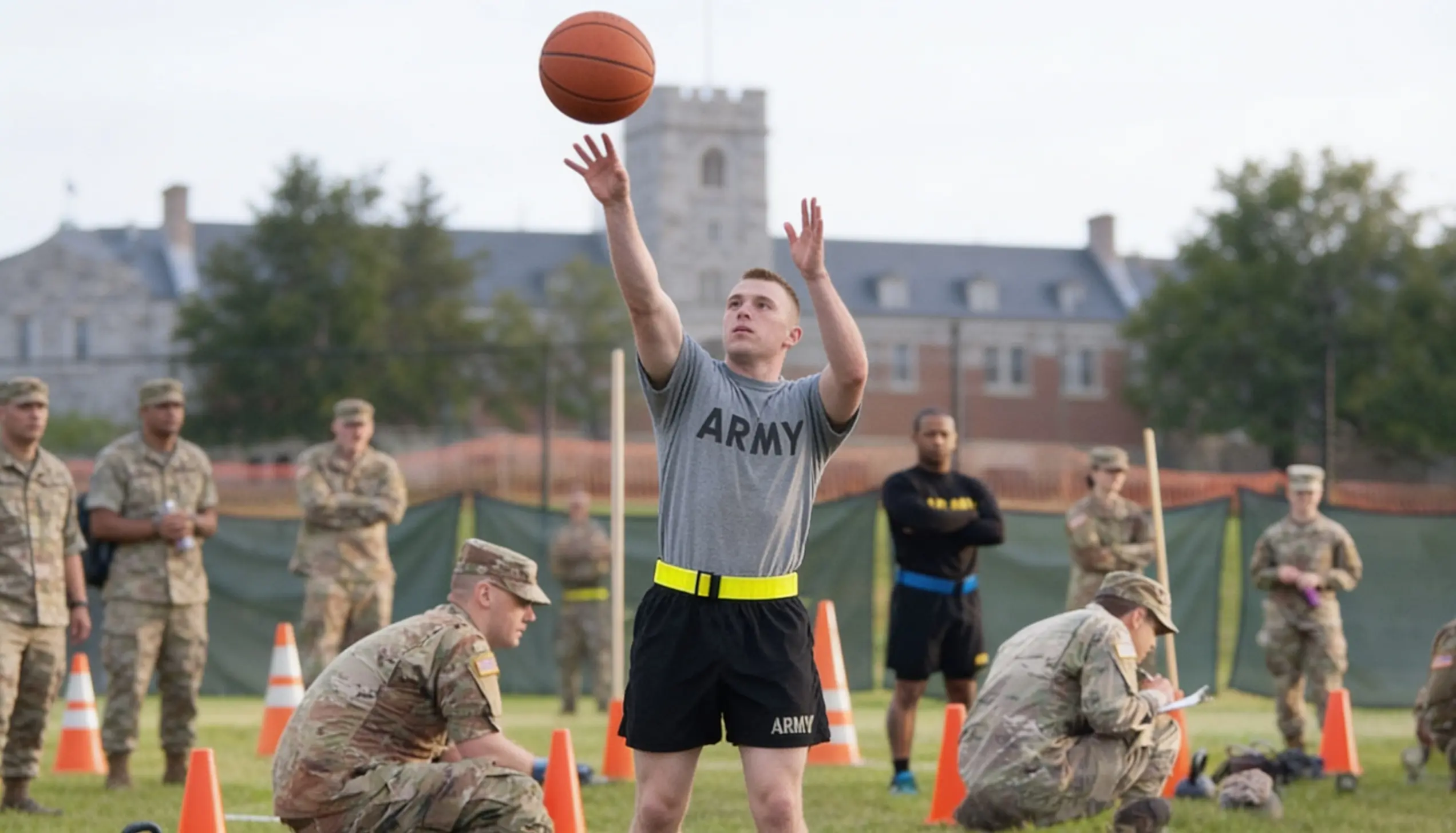
- Basketball throw: From a kneeling position, you throw a men’s basketball one-handed and overhand as far as possible, with three attempts in two minutes and the best one counting. It measures upper-body explosive power. The movement is unusual for most athletes but reflects the forceful whole-torso exertion that military tasks demand; maximum benchmarks differ by gender.
- Pull-ups / Flexed-arm hang: Men and women do cadence pull-ups (the 100-point maximum is 18 for men and 7 for women); at West Point, women may instead do the flexed-arm hang, holding chin over bar for up to 40 seconds. Both versions test upper-body pulling strength and correlate with load-carrying performance under field conditions.
- Shuttle run: A short-course agility run measuring acceleration, deceleration, and lateral quickness. Candidates complete the course as quickly as possible; a lower time earns a higher score. This is the CFA’s primary test of functional mobility under time pressure.
- Sit-ups: Maximum repetitions in two minutes, testing core muscular endurance. The maximum benchmark is identical for male and female candidates, making it the CFA’s only fully gender-neutral event.
- Push-ups: Maximum repetitions in two minutes, testing chest, shoulder, and tricep endurance. Full range of motion is required: lower your body as a single unit until your upper arms are at least parallel to the ground, then push back up to full arm extension. Partial reps don’t count toward your score.
- One-mile run: A timed mile measuring aerobic capacity. This is the final event, which means you’re running it already fatigued from the previous five. Faster times earn higher scores on a 0-to-100 conversion scale.
Here’s where it gets interesting. The raw-to-scale conversion isn’t linear. A small performance gain at the high end earns fewer additional points than the same gain at mid-range.
So if you’re already near the maximum, more reps won’t shift your composite much. If you’re below average on one or two events, targeted improvement there can move your score more than any further polish on your strengths.
The scoring methodology is described in the official CFA scoring instructions from West Point Admissions. Raw scores are converted to 0-to-100 scale scores for each event, with fixed 100-point maximums by event and gender (for example, 18 pull-ups and a 5:20 mile for men). That’s an important detail when you’re interpreting your own practice scores.

West Point CFA Scores: What the Maximums Really Mean
Every event on the west point cfa has a published maximum benchmark. Hit that mark and you score 100 on that event. Exceed it and you still score 100; there’s no extra credit above the ceiling.
So the maximums define the boundary of what the scoring system can reward. Here are those benchmarks, as listed on West Point’s admissions page, confirmed against the official scoring PDF used to administer the test:
| CFA Event | Men’s Maximum | Women’s Maximum |
|---|---|---|
| Basketball Throw | 102 ft | 68 ft |
| Pull-Ups / Flexed-Arm Hang | 18 reps | 7 pull-ups or 40-second hang |
| Shuttle Run | 7.8 sec | 8.6 sec |
| Sit-Ups (2 min) | 95 reps | 95 reps |
| Push-Ups (2 min) | 75 reps | 50 reps |
| 1-Mile Run | 5:20 | 6:00 |
So what does that actually mean for you? The maximums tell you where the scoring ceiling sits, but they don’t tell you where the competitive midpoint is. Most accepted candidates aren’t scoring 100 on every event.
They’re consistently above average across the board, with one or two events near the ceiling. That’s a very different target than perfection.
Worth pausing on that for a second. A candidate who scores 85 across all six events typically outperforms one who maxes two events and scores 55 on the rest.
So your priority is raising your lowest events, not continuing to refine the ones you already do well.
One note on the basketball throw: the official PDF instructions list 102 feet as the men’s maximum, and that figure checks out directly against West Point’s own CFA administration document. Some online sources cite 105 feet, a number that appeared on the West Point website at different points. If you’re training toward the maximum, use 102 feet as your target; it’s the figure from the official scoring document.
Is There a Minimum Passing Score for the West Point CFA?
West Point doesn’t publish minimum CFA scores as numbers. The academies have stopped releasing minimum CFA standards as specific numbers over the past decade, leaving candidates to piece together expectations from admissions data and applicant reports.
The way I look at it, this isn’t an accident. Publishing an exact minimum score would shift candidate behavior from competing to clearing. Admissions wants CFA scores to serve as a genuine differentiator, not just a box to check.
That said, competitive data gives you a working picture of where accepted candidates tend to land, event by event:
| Event | Competitive Range (Accepted Candidates) | Risk Flag Below |
|---|---|---|
| Pull-Ups (men) | 10+ reps | Fewer than 7 |
| Shuttle Run | Under 9.0 sec (men) / under 10.0 sec (women) | Slower than these marks |
| Push-Ups | 50+ (men) / 35+ (women) | Well below these marks |
| Sit-Ups | 75+ reps (both) | Well below 75 |
| 1-Mile Run | Under 7:00 (men) / under 8:00 (women) | Slower than these marks |
| Basketball Throw | Responds well to technique work | Least predictive event overall |
But here’s the thing. These are competitive ranges based on patterns in accepted applicants, not official cutoffs. They shift year to year based on who applies.
A score that would have cleared the field three years ago might put you in the middle of the pack this cycle. The only reliable goal is to maximize every event, not to aim at a floor that moves.
How the CFA Differs at West Point, the Air Force Academy, and the Naval Academy
The six events are the same at each academy, but maximum scores and administrator rules differ slightly, so check each academy’s CFA page.
So if you take the CFA for West Point, your score can also be submitted to Annapolis or Colorado Springs. That’s by design; the CFA was developed as a shared evaluation tool across the federal service academies.
What differs significantly is how each academy weighs and uses that score. West Point counts the CFA as about 15% of the overall application score. That’s a meaningful portion but balanced against academics, leadership, extracurriculars, and congressional nomination.
The Naval Academy applies the CFA as an adjustment to the Whole Person Multiple, shifting your score by up to 5% in either direction depending on your performance. That sounds small until you see it against the actual scale: sworn filings in the SFFA v. USNA litigation put the Whole Person Multiple on a range of roughly 40,000 to 80,000 points, with about 58,000 marking the floor for a “qualified” file and roughly 70,000 needed to be considered “highly qualified” for early commitment. A swing of up to 5% on a scale that size is worth a few thousand points, enough to move a borderline file across one of those two thresholds. The Air Force Academy treats it differently still: USAFA calls satisfactory completion of the CFA an important admissions requirement, says your score is a combination of your best efforts on all six events, and publishes admitted-candidate averages to aim for, so a stronger score helps rather than simply clearing a bar.
| Academy | CFA Weight | How It’s Used |
|---|---|---|
| West Point (USMA) | ~15% of application | Scored competitively; contributes directly to overall admissions score |
| Naval Academy (USNA) | Adjusts WPM up to ±5% (of a ~40,000–80,000 point scale) | Modifies the Whole Person Multiple up or down based on performance |
| Air Force Academy (USAFA) | Required; scored across all six events | USAFA publishes admitted-candidate averages to meet or exceed |
The USAFA’s published averages for accepted candidates tend to be lower than USMA competitive profiles. Air Force admitted candidates average around 69 feet on the basketball throw for men, roughly 12 pull-ups, and a 6:29 mile.
This cross-academy structure also affects how you approach the west point fitness test across a multi-academy application. If you’re applying to all three, train to West Point’s competitive standards. Its bar is higher because the score is weighted directly into your USMA package, so clearing the Air Force threshold follows naturally.

Why Do Men’s and Women’s CFA Standards Differ?
The CFA uses gender-normed scoring, which means men and women are evaluated against separate performance benchmarks on most events. This isn’t a recent policy, and it’s not unique to the military academies. Gender-normed scoring mirrors how military fitness tests have long set separate standards for men and women.
Courts have accepted this approach in at least one civilian case. In Bauer v. Lynch (4th Cir. 2016), a federal appeals court held that FBI fitness standards that differ by sex but impose an equal burden of compliance do not violate Title VII.
That case involved FBI Special Agent trainees, not the military, and it is not the legal basis for the service academies’ CFA.
Case background: U.S. Department of Justice, Bauer v. Lynch
So why does this matter? A female candidate who scores 100 on push-ups has completed 50 reps; a male candidate needs 75. Both performances are treated as equivalent within their respective pools, which means you’re competing against candidates evaluated by the same standard, not across gender lines.
The one exception is sit-ups. The CFA maximum is 95 reps for both men and women, making it the only fully gender-neutral event on the test. That shared benchmark reflects the research finding that core endurance differences between male and female athletes are small enough that the academies chose not to apply separate standards here.
Is the West Point CFA the Same as the Army Fitness Test (AFT)?
No. After covering military fitness assessments for several years, I still see this confusion trip up applicants regularly. The CFA is an admissions evaluation for high school candidates seeking entry to a service academy.
The Army Fitness Test (AFT) is an in-service fitness standard administered to active-duty soldiers, reservists, and National Guard members throughout their careers. The two tests have different purposes, different events, and different populations.
The CFA is taken as part of your application (you can retake it to improve your score), measuring pre-service physical potential. The AFT is administered repeatedly throughout a soldier’s career with real consequences: promotion eligibility, assignment options, and continuation of service.
A weak CFA has admissions implications. A failed AFT has career implications.
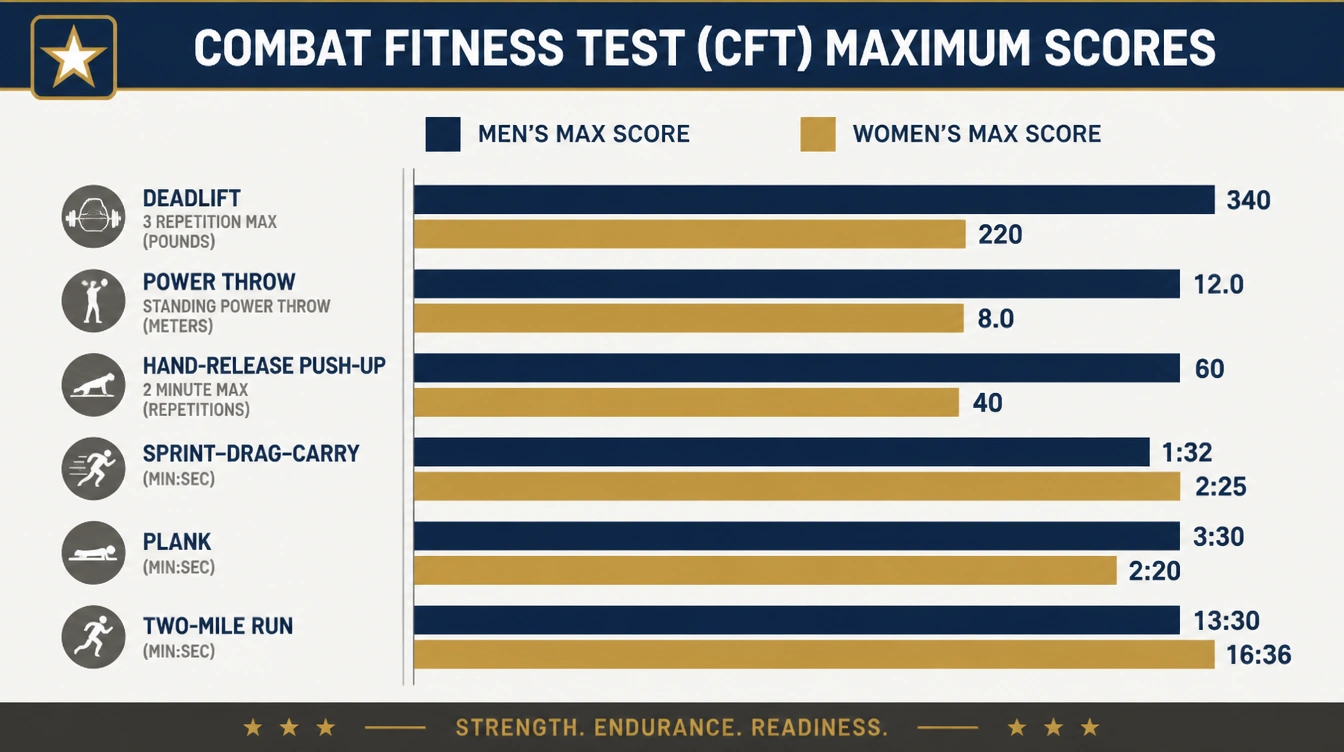
The events don’t overlap. The Army Fitness Test (AFT), which replaced the ACFT as the Army’s test of record on June 1, 2025, has five events: a three-repetition maximum deadlift, hand-release push-ups, the sprint-drag-carry, a plank, and a two-mile run. The CFA tests the basketball throw, pull-ups or flexed-arm hang, shuttle run, sit-ups, push-ups, and a one-mile run.
And that’s just one part of it. The AFT predicts injury risk and combat readiness in trained soldiers; the CFA identifies which high school athletes have the physical baseline to succeed in academy training.
Training for the CFA doesn’t prepare you for the AFT, and vice versa. These are different evaluation goals for different populations at different stages.
Frequently Asked Questions
What other West Point requirements should I know about besides the CFA?
The west point requirements go well beyond physical fitness. You’ll need a congressional nomination from your senator or representative, and those requests must go out the spring or summer before your senior year. You’ll also need a medical qualification through DoDMERB, competitive SAT or ACT scores, and a demonstrated leadership record through school, sports, or community involvement. The CFA is one component of West Point’s Whole Candidate Score alongside academics and leadership. A strong CFA won’t overcome a failed medical review or a missing nomination, which is why successful candidates work every part of their application simultaneously.
Can I retake the CFA if I don’t like my score?
Yes. West Point says applicants can always retake the CFA to improve their score, but each reported score must come from a single, complete six-event administration. Practice all six events in order before each attempt.
Do I need to record video of my pull-ups or push-ups for the CFA?
No. West Point no longer requires video documentation of any CFA events, including pull-ups or push-ups. Some older prep guides and third-party admissions sites still instruct candidates to record their sessions, but this requirement was discontinued. For West Point, the CFA must be given by a PE teacher, a Military Academy Liaison Officer, a Field Force representative, a U.S. military officer or NCO, or a JROTC/ROTC instructor, and never by a relative or coach. The administrator enters your scores through an emailed online link. Confirm the current administration procedures with your admissions officer before your test date, since procedural details can update between cycles.
Does ROTC use the same Candidate Fitness Assessment?
No. ROTC programs don’t use the CFA; the test is specific to the federal service academies. ROTC scholarships and contracting use different physical standards depending on the branch and program. Army ROTC evaluates contracted cadets using the Army Fitness Test (AFT), not the six-event CFA format. The CFA was developed specifically for academy admissions and doesn’t carry over into ROTC contexts in any official way. Training for the CFA won’t automatically prepare you for ROTC fitness requirements, even within the same branch.
Service Academy Admissions, Step by Step
- Secure a congressional nomination
- Pass the Candidate Fitness Assessment
- Clear the DoDMERB medical exam
- Compare acceptance rates: West Point, Naval Academy, Air Force Academy, Coast Guard Academy, Merchant Marine Academy
Where This Leaves Your CFA Prep
West Point doesn’t publish a minimum score as a number, which means the floor is competitive in practice. It moves based on who applies in any given cycle.
The safest interpretation: train toward the maximum benchmarks on every event, treat any score below 70 as a risk worth addressing, and build your prep around the full six-event sequence rather than isolated performance in a single test.
Most CFA-specific training programs run eight to twelve weeks. That’s enough time to see meaningful gains across all six events if you train them as a system. The basketball throw responds fastest to technique work rather than pure strength; two weeks of focused throw mechanics can add ten to fifteen feet without significant conditioning investment.
The test is administered in one session. Your prep needs to reflect that. Running a full practice CFA including all six events in order with minimal rest between them is the most valuable single training session you can do in the two weeks before your test date.
For more on academy preparation and service academy resources, including nomination timelines and DoDMERB guidance, the full range of military education options is worth understanding before committing to a single path. The CFA is a significant piece of the West Point application, but it’s one piece. Strong candidates build every component of their package at the same time.

William Johnson writes about U.S. military training and enlistment for Servicemembers Opportunity Colleges. His work covers topics such as boot camp, ROTC, the ASVAB test, military pay, and what to expect during basic training, with a focus on giving recruits and their families clear, practical information about military life.
Sources
- United States Military Academy. “Candidate Fitness Assessment.” West Point Admissions, 2024.
- United States Military Academy. “CFA Instructions and Scoring Guide.” West Point Admissions, 2024.
- United States Naval Academy. “Whole Person Multiple.” USNA Admissions, 2024.
- United States Naval Academy. “Candidate Fitness Assessment.” USNA Admissions, 2024.
- Air Force Academy Admissions. “Physical Requirements.” Academy Admissions, 2024.
- The Academician. “Failing the Candidate Fitness Assessment.” Academician.us, December 2025.
- United States Military Academy. “Candidate Fitness Assessment (CFA) FAQ.” West Point Admissions, 2026.
- Gain Service Academy Admission. “Naval Academy Acceptance Rate: What 8% Really Means,” citing sworn filings in SFFA v. USNA. 2026.