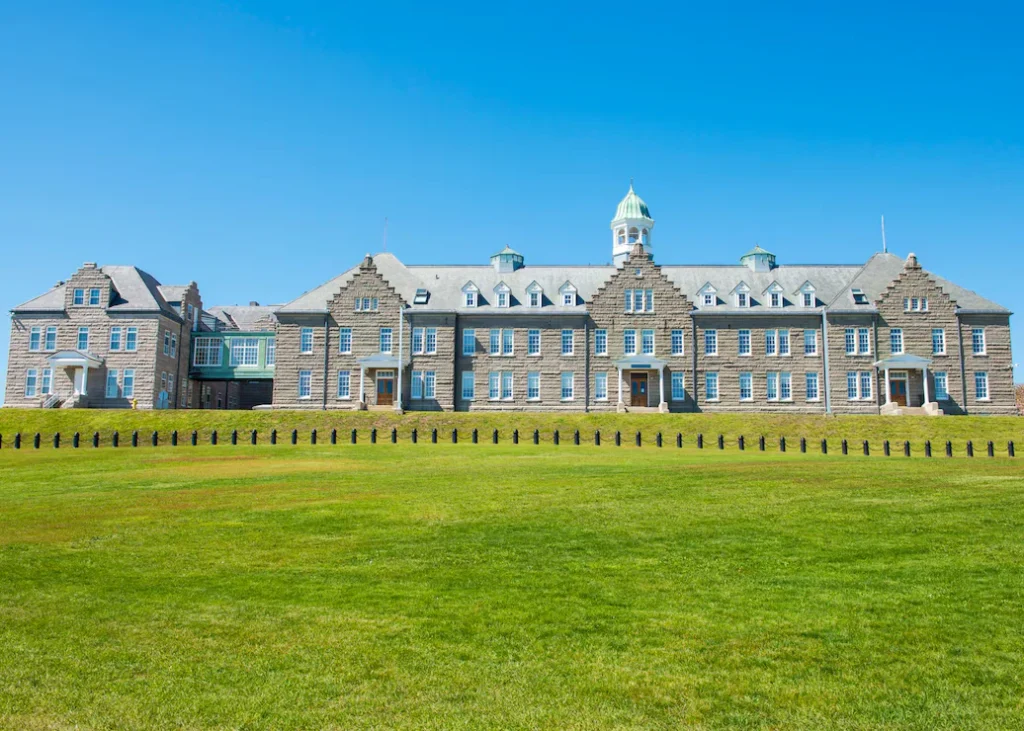

The U.S. Naval War College (NWC) in Newport, Rhode Island, is the Navy’s graduate-level professional military education school, founded in 1884. It runs two 10-month resident colleges for U.S. students: the College of Naval Command and Staff for intermediate officers (O-3/O-4), which awards a Master of Arts in Defense and Strategic Studies and JPME Phase I, and the College of Naval Warfare for senior officers (O-5/O-6), which awards a Master of Arts in National Security and Strategic Studies and JPME Phase II. It also runs two international colleges and several distance education programs.
The Naval War College educates officers from every U.S. service, federal civilians, and officers from partner navies. Students don’t apply the way they would to a civilian graduate school. Their service or agency selects them, and they arrive on orders for a year in Newport.
This guide explains how the two resident colleges differ, who attends, how selection works, what the degrees are called, how the distance programs work, and how the senior course compares with the other war colleges.

In This Article
- What the Naval War College Is
- Two Resident Colleges, Two Degrees
- Who Attends and How Students Are Selected
- The Resident Curriculum
- Distance Education Options
- Wargaming and Research
- International Colleges and Career Impact
- Comparing Senior Service Colleges
- Frequently Asked Questions
- Where This Leaves You
What the Naval War College Is
The Naval War College began in 1884, and its first class in 1885 had nine students. The college describes itself as the oldest institution of its kind in the world, with more than 50,000 graduates across its programs. Its campus is in Newport, Rhode Island, on Narragansett Bay.
The college states its mission this way on its official website:
“The mission of the U.S. Naval War College is to educate and develop future leaders by growing strategic perspectives, critical thinking, and cultural awareness.”
U.S. Naval War College, About (usnwc.edu)
Besides teaching, the college calls itself the Navy’s “Home of Thought.” It runs research centers, a press that publishes the Naval War College Review, and a wargaming department that supports Navy and joint commands. It is accredited by the New England Commission of Higher Education (NECHE) to award its two master’s degrees, and by the Chairman of the Joint Chiefs of Staff to award JPME Phases I and II.
Two Resident Colleges, Two Degrees
The most common point of confusion is that NWC has two separate resident colleges for U.S. students, at two career stages, with two different degrees.
| Feature | College of Naval Command and Staff (intermediate) | College of Naval Warfare (senior) |
|---|---|---|
| Military students | O-3/O-4: majors and lieutenant commanders (some lieutenants with a waiver) | O-5/O-6: commanders and captains, or those selected for those grades (some lieutenant commanders with a waiver) |
| Civilian students | GS-13 to GS-14 or equivalent | GS-14 to GS-15 or equivalent |
| Degree | Master of Arts in Defense and Strategic Studies | Master of Arts in National Security and Strategic Studies |
| Joint education credit | JPME Phase I | JPME Phase II |
| Length | 10 months, three trimesters | 10 months, three trimesters |
| Resident students, AY 2022-23 | 288 | 192 |
| International counterpart | Naval Staff College | Naval Command College |
Both degrees are accredited by NECHE. The college was first accredited in 1991 to award the Master of Arts in National Security and Strategic Studies, and in 2015 the accreditation was expanded so that the intermediate course awards its own degree.
Who Attends and How Students Are Selected
NWC graduates about 525 students a year from its in-residence programs and more than 1,000 from distance programs, according to its Fast Facts sheet for 2022-23. That year, 480 resident students were on campus. In the senior course, U.S. Army officers made up 23 percent and international officers 24 percent, followed by the Navy (18 percent), federal civilians (13 percent), the Air Force (11 percent), the Marine Corps (7 percent), and the Space Force and Coast Guard (2 percent each).
There is no standard application. The college says services and federal agencies nominate students for the senior course based on their potential for greater responsibility. For Navy officers, that means the Navy’s personnel and detailing system screens and assigns you, and you receive orders to Newport. Other services slate officers through their own centralized processes. Civilian agencies nominate their own people.
Officers reach Newport from every commissioning source: the United States Naval Academy, the United States Military Academy and the other service academies, ROTC units at civilian universities, Officer Candidate School, and the corps of cadets at senior military colleges such as the Virginia Military Institute. By the time they arrive, most have spent a decade or more in the fleet or the field.
Seminars mix services on purpose. A Navy surface warfare officer may share a table with an Army aviator, an Air Force space operator, a Marine, a federal civilian, and an international officer.
The Resident Curriculum
Both resident colleges run a 10-month year split into three trimesters. Instruction is mostly small seminars, with capstone exercises, wargames, and substantial writing.
College of Naval Warfare (senior course)
Senior students take five core courses, a year-long leadership course, and three electives, one per trimester. The core areas are national security decision making, strategy and policy, joint military operations, and Leadership in the Profession of Arms. Graduates earn the Master of Arts in National Security and Strategic Studies and JPME Phase II.
College of Naval Command and Staff (intermediate course)
Intermediate students study Joint Maritime Operations, Theater Security Decision Making, Strategy and War, and Leadership in the Profession of Arms, plus electives. U.S. resident graduates earn the Master of Arts in Defense and Strategic Studies and become eligible for JPME Phase I certification.
Both colleges draw on a catalog of more than 120 electives, from the anthropology of war to science, technology, and strategy. The college also holds graduations in both June and November.

Officers who previously earned engineering degrees at the Naval Postgraduate School often find this a big change, moving from technical problem sets to history, policy, and strategy. NPS is a separate graduate school in Monterey, California, not a war college, though NWC runs a JPME program there.
Distance Education Options
Many officers complete Naval War College coursework without moving to Newport. The College of Distance Education offers intermediate-level (JPME Phase I) programs:
- Fleet Seminar Program: evening seminars that meet one night a week for three hours at Navy bases and stations, including Norfolk, San Diego, and Pearl Harbor. Students usually finish in about three years and earn JPME Phase I and an NWC diploma.
- Naval Command and Staff Online Program: the JPME Phase I curriculum delivered online.
- Graduate Degree Program: lets Fleet Seminar students and graduates earn the Master of Arts in Defense and Strategic Studies. It requires 30 semester credit hours, and Fleet Seminar students can apply after completing at least seven credit hours. The college says the degree can be finished in about 18 months when combined with the Fleet Seminar Program.
- NWC at NPS Program: a satellite program at the Naval Postgraduate School in Monterey.
Eligibility for the Fleet Seminar and Graduate Degree programs is O-3 and above for the Navy, Marine Corps, and Coast Guard; O-4 and above for other services; and GS-11 and above for federal civilians. Contractors are not eligible. The distance programs are intermediate level. The senior course and its JPME Phase II credit are resident only.
Wargaming and Research
The college’s Wargaming Department was established in 1887 and is now part of the Center for Naval Warfare Studies. Its games simulate conflicts from sea to space to cyberspace. The college says this work enriches the curriculum and helps shape defense plans and policies for commands and agencies. Students take part in wargames as part of their courses, and the center also runs research groups on strategy and warfare.
Wargames don’t make decisions or buy ships. They test concepts and plans so leaders can see where an approach is likely to break before it is tried for real.
International Colleges and Career Impact
About 110 international officers from partner nations study at NWC each year. They attend two dedicated colleges:
- Naval Command College: an 11-month program for senior officers from navies around the world, with more than 40 countries represented each year. Since 1956, more than 2,100 officers from 91 nations have completed it, and the college says more than half reached flag rank.
- Naval Staff College: an 11-month program for mid-career international officers, with coursework and field study trips across the United States.
For U.S. officers, the senior course is a career milestone. JPME Phase II is a key step toward Joint Qualified Officer status, which matters for later promotion to flag or general officer. College of Naval Warfare graduates often move on to major command, such as a ship, squadron, or air wing, or to senior staff jobs in the fleet, on the Joint Staff, or at combatant commands. The 2022-23 Fast Facts note that nearly 300 of today’s active-duty admirals, generals, and Senior Executive Service leaders are alumni.

Comparing Senior Service Colleges
The College of Naval Warfare is one of six senior service colleges that give U.S. officers JPME Phase II and a master’s degree. The Army’s own senior service college is the U.S. Army War College at Carlisle Barracks, Pennsylvania, and the joint National War College sits at Fort McNair in Washington.
| College | Location | Students (latest published figure) | Degree | Resident Length |
|---|---|---|---|---|
| Naval War College, College of Naval Warfare | Newport, Rhode Island | 192 senior-course students (AY 2022-23) | Master of Arts in National Security and Strategic Studies | 10 months |
| National War College (NDU) | Fort McNair, Washington, D.C. | About 200 (Class of 2027) | Master of Science in National Security Strategy | 10 months, from August |
| Eisenhower School (NDU) | Fort McNair, Washington, D.C. | About 330 per year | Master of Science in National Resource Strategy | 10 months, August to June |
| U.S. Army War College | Carlisle Barracks, Pennsylvania | About 340 U.S. JPME II graduates a year, plus about 80 International Fellows | Master of Strategic Studies | Early August to early June |
| Air War College | Maxwell AFB, Alabama | About 245 resident students a year | Master of Strategic Studies | July to May |
| Marine Corps War College | Marine Corps Base Quantico, Virginia | Small student body (MCU does not publish a set number) | Master of Strategic Studies | One academic year, August to June |
Newport’s distinguishing features are its maritime focus, its long wargaming tradition, and the fact that it runs intermediate and senior courses side by side. Don’t confuse any of these with the senior military colleges, which are undergraduate schools with a corps of cadets.
Frequently Asked Questions
Can I apply to the Naval War College as a civilian?
Only as a federal employee nominated by your agency for the resident courses, or as an eligible federal employee (GS-11 and above) in the distance programs. Private citizens and contractors are not eligible.
Which degree will I earn?
It depends on the college. Senior College of Naval Warfare graduates earn a Master of Arts in National Security and Strategic Studies. Intermediate College of Naval Command and Staff graduates, and distance Graduate Degree Program graduates, earn a Master of Arts in Defense and Strategic Studies.
Can I get JPME Phase II through distance education?
Not through the Naval War College. Its distance programs award JPME Phase I. JPME Phase II comes from the resident College of Naval Warfare or another senior-level resident program.
Is the Naval War College the same as the National War College?
No. Both are often called NWC, but the Naval War College is a Navy school in Newport, Rhode Island, and the National War College is a joint National Defense University college in Washington, D.C.
Where This Leaves You
The Naval War College is really several schools in one: an intermediate college that awards JPME Phase I and a Master of Arts in Defense and Strategic Studies, a senior college that awards JPME Phase II and a Master of Arts in National Security and Strategic Studies, two international colleges, and distance programs that reach officers across the fleet. Most officers meet it at least once, often first through the Fleet Seminar or online program. Getting to the resident courses in Newport still depends on selection by your service, which follows from a strong record in your early and mid-career jobs.

William Johnson writes about U.S. military training and enlistment for Servicemembers Opportunity Colleges. His work covers topics such as boot camp, ROTC, the ASVAB test, military pay, and what to expect during basic training, with a focus on giving recruits and their families clear, practical information about military life.
Sources
- U.S. Naval War College. “About U.S. Naval War College.” usnwc.edu, 2026.
- U.S. Naval War College. “Fast Facts, Academic Year 2022-2023.” usnwc.edu, 2023.
- U.S. Naval War College. “College of Naval Warfare.” usnwc.edu, 2026.
- U.S. Naval War College. “JPME Phase II and Master’s Degree.” usnwc.edu, 2026.
- U.S. Naval War College. “College of Naval Command and Staff.” usnwc.edu, 2026.
- U.S. Naval War College. “JPME Phase I and Master’s Degree.” usnwc.edu, 2026.
- U.S. Naval War College. “College of Distance Education.” usnwc.edu, 2026.
- U.S. Naval War College. “Fleet Seminar Program.” usnwc.edu, 2026.
- U.S. Naval War College. “Graduate Degree Program.” usnwc.edu, 2026.
- U.S. Naval War College. “Naval Command College.” usnwc.edu, 2026.
- U.S. Naval War College. “Naval Staff College.” usnwc.edu, 2026.
- National War College. “Dean of Students Welcome Letter, Class of 2027.” nwc.ndu.edu, 2026.
- Eisenhower School. “Eisenhower Students.” es.ndu.edu, 2026.
- U.S. Army War College. “About the U.S. Army War College.” army.edu, 2026.
- Air War College. “About.” airuniversity.af.edu, 2026.
- Marine Corps University. “AY 2025-26 MCU Course Catalog.” usmcu.edu, 2025.