
What is AIT? It stands for Advanced Individual Training, the Army’s job school that a new Soldier attends after Basic Combat Training. This page covers the Army’s AIT only, not other uses of the same three letters.
Across 123 entry-level Army jobs listed on goarmy.com, the median AIT is 15 weeks. That makes basic training plus AIT about 25 weeks (roughly 5.7 months) for the typical recruit. One AIT in three is 10 weeks or shorter, and one in four runs past 20 weeks, based on data collected Oct 17, 2026.
A handful of jobs skip the split entirely. One Station Unit Training (OSUT) folds basic and AIT into a single course.
Here are the AIT army basics at a glance.
| Item | As of Oct 2026 |
|---|---|
| Stands for | Advanced Individual Training |
| Comes after | Basic Combat Training, except OSUT jobs |
| Typical length | Median 15 weeks; 6 to 52 weeks across 123 jobs |
| Basic + AIT | Median about 25 weeks (about 5.7 months) |
| Who sets AIT privileges | The brigade commander |
| Test pass mark | 70 percent |
What Is AIT in the Army?
AIT is the job training a new Soldier takes after basic, and finishing it makes that Soldier qualified in a military occupational specialty (MOS). The AIT meaning in the Army is Advanced Individual Training, and goarmy.com ties both the school and its length to the Soldier’s MOS.

The Army National Guard’s AIT page puts the end result in one line: “Upon completion of AIT, you will be MOS Qualified, or MOSQ.”
AIT isn’t a separate system for part-time Soldiers. TRADOC Regulation 350-6, the August 28, 2025 rulebook for initial entry training, “applies to all Regular Army, U.S. Army Reserve, and Army National Guard enlisted initial entry training.” Guard and Reserve recruits train under the same regulation as active-duty recruits.
Where Is AIT?
Army AIT runs at 17 schools, according to goarmy.com. Those schools sit on a short list of installations, and several of them changed names in 2025.
The June 2025 base renaming restored older names: Fort Gregg-Adams became Fort Lee, Fort Eisenhower became Fort Gordon, and Fort Novosel became Fort Rucker. Fort Moore went back to Fort Benning under a memo dated March 3, 2025. Some guides still use the previous names, so the table below uses the current ones.
| Base | Schools or center of excellence | Source |
|---|---|---|
| Fort Benning | Infantry School, Armor School (Maneuver Center of Excellence) | home.army.mil |
| Fort Leonard Wood | Engineer, CBRN and Military Police schools | home.army.mil |
| Fort Gordon | Cyber Center of Excellence, Signal School | home.army.mil |
| Fort Huachuca | Intelligence Center of Excellence | home.army.mil |
| Fort Sill | Fires Center of Excellence (Field Artillery, Air Defense Artillery) | home.army.mil |
| Fort Rucker | Aviation Center of Excellence | home.army.mil |
| Fort Lee | CASCOM: Ordnance, Quartermaster, Transportation | home.army.mil |
| Fort Jackson | Soldier Support Institute | home.army.mil |
| JBSA Fort Sam Houston | Medical Center of Excellence (MEDCoE) | home.army.mil |
| Presidio of Monterey | Defense Language Institute Foreign Language Center | home.army.mil |
Three limits apply to this table. It isn’t a complete list of AIT sites. The Fort Lee page lists CASCOM’s schools but doesn’t confirm where each one physically sits.
There’s also no public map that ties each MOS to a base. The goarmy page for the specific MOS is the place to check.
How Is AIT Training Different From Basic Training?
AIT is MOS training that starts after Basic Combat Training, and the rules loosen in specific, written ways once a trainee arrives. The biggest difference, though, is length.
Basic runs 10 weeks, a figure stated on goarmy’s MOS pages and in TR 350-6. AIT is longer for most jobs: 81 of 123 AIT courses, or 66%, last more than 10 weeks.
Supervision thins out on paper as well. TR 350-6 plans a basic training company at 200 trainees for 16 drill sergeants, or 12.5 trainees each, while AIT drill sergeant staffing is “Based on Structure Load (1:20).” Those are planning ratios from the regulation, not a headcount at any school.
During basic (Phase I through Phase IV), off-post passes are allowed only “for Family Day and Graduation Day.” Phone time in those phases comes “on Sundays and based on performance, during the week.” Both rules cover basic only, and the 2025 regulation sets no Army-wide AIT pass schedule.
Tobacco and nicotine are banned from Phase I through Phase IV. For AIT, the regulation hands the decision to local leaders: “Brigade commanders will establish local policies governing tobacco products for Trainees in Phases V – VI+.”
| Rule | Basic (Phases I–IV) | AIT (Phases V–VI+) | Source |
|---|---|---|---|
| Length | 10 weeks | 6 to 52 weeks, depending on the MOS | goarmy.com; TR 350-6 |
| Drill sergeant planning load | 200 trainees per 16 drill sergeants (12.5 each) | 1:20, based on structure load | TR 350-6, Table B-1 |
| Off-post passes | Family Day and Graduation Day only | No Army-wide schedule; set locally | TR 350-6, Table 2-2 |
| Phones | Sundays, plus weekdays based on performance | Set locally (see the phases section) | TR 350-6, para 2-6c |
| Tobacco and nicotine | Banned | Brigade commander sets local policy | TR 350-6, para 2-6d |
What about a typical day? TR 350-6 sets no Army-wide daily timetable for AIT; days are built around classes, field training and PT set by each school.
How Long Is AIT?
It depends on the job. Across 123 entry-level Army jobs, the median AIT is 15 weeks, the middle half of courses runs 9 to 20 weeks, and the full range is 6 to 52 weeks.
The Army’s AIT overview page says courses run “between four to 52 weeks.” Here’s where it gets interesting. Most courses sit far from both ends: the average is 17 weeks, and one in three is 10 weeks or shorter.
| AIT length | Courses | Share |
|---|---|---|
| 1 to 10 weeks | 42 | 34% |
| 11 to 20 weeks | 51 | 41% |
| 21 to 30 weeks | 17 | 14% |
| 31 to 52 weeks | 13 | 11% |
| All 123 jobs | Median 15 weeks | 100% |
Source: goarmy.com job pages, data collected Oct 17, 2026. Lengths change, so check the MOS page before relying on any single number.
Put another way, 30 of the 123 courses (24%) run past 20 weeks. The short end is crowded too: seven jobs list just 6 weeks of AIT (13B, 68J, 88K, 88M, 88N, 88U and 92S), while 68C and 68K each run 52 weeks.
Medical jobs make up a large part of the long tail. Of the 13 courses that run past 30 weeks, 6 belong to medical career field 68 (68A, 68C, 68K, 68L, 68P and 68V). The courses of 36 weeks or more are 68C (52), 68K (52), 68P (46), 94S (45), 68A (44), 35T (37), 94M (37), 17C (36), 68V (36) and 89D (36).
| MOS code | AIT weeks shown on goarmy (Oct 17, 2026) |
|---|---|
| 13B | 6 |
| 88M | 6 |
| 92S | 6 |
| 92G | 8 |
| 91H | 13 |
| 68M | 15 |
| 31K | 18 |
| 15D | 20 |
| 68D | 21 |
| 35T | 37 |
| 94S | 45 |
| 68P | 46 |
| 68C | 52 |
| 68K | 52 |
| 68W | See the combat medic guide |
The table lists codes only. Each code’s job title and current length are on its goarmy MOS page.
How these numbers were counted: the source is goarmy.com’s job data feed, the file that builds its MOS pages, pulled on Oct 17, 2026. It held 148 enlisted records; removing 8 in-service-only codes left 140 entry-level jobs, and 123 of them list a single AIT number.
OSUT jobs, jobs with a range (13U at 6 to 10 weeks, 14U at 7 to 20, and 35P) and 35W were counted separately. The displayed “Testing & Certifications” block was checked in a browser on the 88M page, which reads “10 weeks of Basic Training / 6 weeks of AIT.”
One caveat matters. The feed’s older text field disagrees with the displayed block by at least a week for 28 of the 123 jobs, for example 88M (6 vs 7 weeks) and 17C (36 vs 45).
The figures here use the displayed values. That split is why different blogs quote different numbers for the same job.
Is There an AIT Military Equivalent in Other Branches?
AIT is an Army term, but every branch runs a job school after boot camp. The lengths below come from each branch’s official recruiting or school site, checked in October 2026.
| Branch | Job school | Length | Basis |
|---|---|---|---|
| Army | Advanced Individual Training (AIT) | Median 15 weeks | 123 goarmy.com job pages |
| Air Force | Technical training (tech school) | Median 9.4 weeks; 3.4 to 56.4 weeks | 83 airforce.com career pages |
| Navy | A-school | 5 to 24 weeks; nuclear MMN pipeline 6 + 6 + 6 months | 7 sampled ratings, navy.com |
| Coast Guard | A-school | 8 to 28 weeks; median 15 | 21 ratings, gocoastguard.com |
| Marine Corps | Marine Combat Training, then MOS school | MCT 29 days (about 4.1 weeks) for non-infantry; Infantry Marine Course 14 weeks | School of Infantry West |
The Army’s median runs about five and a half weeks longer than the Air Force’s. The Navy figure comes from a sample of seven ratings, so it’s a snapshot rather than a full count.
How Long Is Army Basic Training and AIT Together?
For jobs with a single AIT number, basic training plus AIT runs 16 to 62 weeks, with a median of 25 weeks (about 5.7 months). The longest of those paths works out to roughly 14.3 months. Two groups break the pattern: OSUT jobs and language jobs.
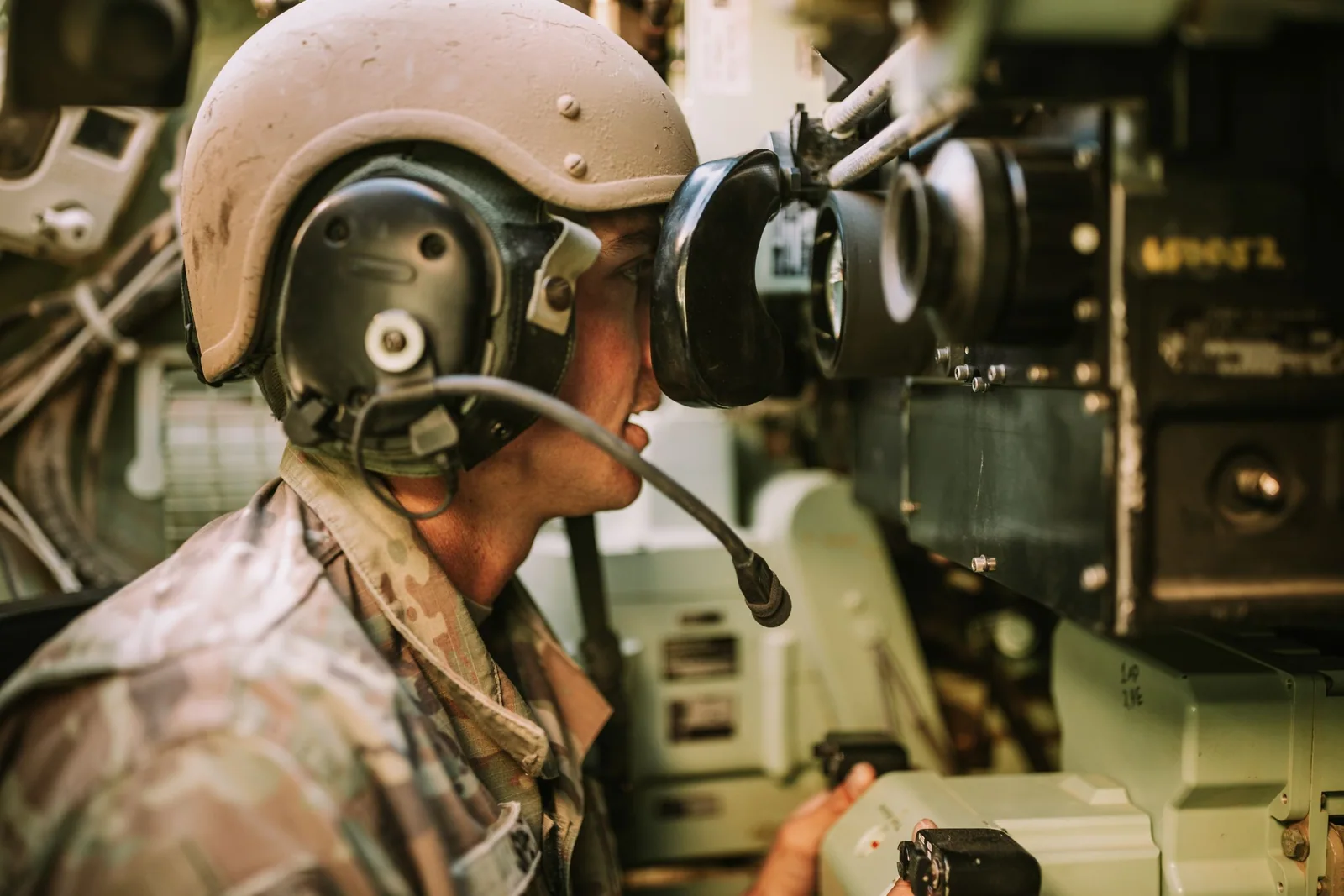
OSUT combines basic and AIT in one course, and goarmy lists those courses at 14 to 22 weeks. TR 350-6 confirms the OSUT course types in its Table B-1.
Language jobs are the other exception. If the Soldier isn’t fluent, goarmy adds 36 to 64 weeks at the Defense Language Institute for 35P, 35M and 35W.
For a 35P linguist, that means basic (10 weeks) plus DLI (36 to 64) plus AIT (5 to 20), or 51 to 94 weeks in total. That’s 11.7 to 21.6 months. DLI and AIT alone come to 41 to 84 weeks, well past the range goarmy quotes for AIT schools.
The “70+ weeks” figure seen online likely traces back to the 2022 edition of TR 350-6, which said “At DLIFLC Phase V+ extends up to 70+ weeks.” That edition has since been replaced.
| Path | Basic | Job school | Total weeks |
|---|---|---|---|
| Shortest AIT | 10 | AIT 6 | 16 |
| Median AIT | 10 | AIT 15 | 25 |
| Longest AIT | 10 | AIT 52 | 62 |
| OSUT 12B, 12C | Included | OSUT 14 | 14 |
| OSUT 19C | Included | OSUT 18 | 18 |
| OSUT 31B | Included | OSUT 20 | 20 |
| OSUT 11B, 11C, 19D, 19K | Included | OSUT 22 | 22 |
| Linguist 35P (not fluent) | 10 | DLI 36 to 64 + AIT 5 to 20 | 51 to 94 |
| 35M (if DLI is required) | 10 | DLI 36 to 64 + AIT 20 | 66 to 94 |
Source: goarmy.com job data, Oct 17, 2026. Basic is counted at 10 weeks.
What AIT Pays in 2026
The goarmy AIT page says pay arrives “on the first and fifteenth.” The rates below come from the DFAS enlisted basic pay table, effective January 1, 2026.
| Grade | Monthly basic pay (2026) |
|---|---|
| E-1, under 4 months of service | $2,225.70 |
| E-1, 4 months or more | $2,407.20 |
| E-2 | $2,697.90 |
| E-3 | $2,836.80 |
For a recruit who entered as an E-1, basic pay over the whole AIT comes to about $3,082 for a 6-week course, $8,039 for a median-length 15-week course and $31,027 for a 52-week course. Those estimates assume E-1 entry with no waiver or advanced rank, and count only the E-1 and E-2 rates. Taxes and deductions aren’t counted.
Two raises can land mid-course. Reception before basic lasts 3 to 7 days under TR 350-6, so the E-1 rate rises at four months of service, around week 6 or 7 of AIT.
AR 600-8-19 (March 6, 2026) makes promotion to PV2 automatic at six months’ time in service. That lands around week 15 or 16 of AIT, inside the course for 48% to 53% of jobs (59 to 65 of 123).
Meals are a separate line. BAS of $476.95 a month is paid to all enlisted members, but members pay for their meals, so it isn’t added to the totals above.
Do You Go Straight to AIT After Basic?
Normally, yes. TR 350-6 says “Trainees are not normally afforded opportunities to take leave other than emergency leave,” and goarmy says there is “no official break” between basic and AIT beyond time to travel. OSUT trainees don’t move at all.
The regulation lists four written conditions. But the real question is this: is the AIT course 24 weeks or longer? That single fact decides whether a one-week delay is built in.
Courses of 24 weeks or longer “have a one-week delay built into ATRRS,” and the trainee “may elect to take up to one week of leave or report directly to AIT.” By the goarmy count, 23 of 123 jobs (19%) qualify: 12D, 12G, 15N, 17C, 17E, 25S, 35N, 35T, 46S, 46V, 68A, 68C, 68F, 68K, 68L, 68P, 68V, 89D, 94D, 94H, 94M, 94S and 94Y.
The second exception follows the calendar. Trainees who “graduate from BCT in December with an AIT start in January are authorized to take holiday block leave,” which runs “20 December through 2 January each year (14 days).” It’s voluntary, and brigade commanders may shift it up to three days earlier or two days later, but not both.
The third condition cuts the other way. Anyone who took holiday block leave during basic is “not authorized to take any additional leave between BCT graduation and the start of AIT.”
The fourth is open to anyone. Para 8-7c(4) of the archived TR 350-6 text reads: “Battalion commanders may grant exceptions on a case-by-case basis.”
| Condition | Who it covers | TR 350-6 para |
|---|---|---|
| One-week delay built in | AIT courses of 24 weeks or longer; up to one week of leave or report directly | 8-7c(1) |
| Holiday block leave | BCT graduates in December with an AIT start in January | 8-7c(2) |
| No extra leave | Anyone who already took holiday block leave during BCT | 8-7c(3) |
| Case-by-case exception | Any trainee, at the battalion commander’s discretion | 8-7c(4) |
Getting to AIT follows a few written rules:
- Family may drive the Soldier, since travel is allowed “including with family members in personally owned vehicles (POVs)” (para 8-5a).
- Travel time is one day per 350 miles (para 8-5b).
- Arrival is due by 18:00 on the Sunday before the course starts (para 8-5b).
Guard recruits have one more route. The National Guard says a recruit may go to AIT “right after Basic Combat Training or after your Phase 2 RSP.”
Can Your Family Move to the AIT Location?
For most recruits, no. TR 350-6 is blunt: “IET Trainees are not authorized shipment of household goods or dependents to the training location.”
Exceptions exist only “if attending an AIT of 20 weeks or more,” and only for a closed list:
- Trainees at the Defense Language Institute (DLI)
- Prior-service trainees attending AIT or OSUT
- MOS reclassification trainees
- 68B, 68C, 68D, 68F, 68K, 68L, 68P, 68Q, 68V, 68X or 68Y trainees in Phase VI+ hospital-based training
- 18X trainees upon graduation from OSUT
The 2025 edition’s summary of change notes that it “Updates which Military Occupational Specialty are authorized household goods shipment to AIT.” The advice found online that an AIT longer than six months lets the family move isn’t the rule for an ordinary recruit.
Army AIT Phases: Phones, Passes and Who Decides
AIT runs in Phase V (Black) and Phases VI and VI+ (Gold). Since the August 28, 2025 edition of the current TR 350-6 text, the brigade commander at each school decides AIT privileges.

| Phase | Color | When |
|---|---|---|
| I | Yellow | Weeks 1 to 2 (basic) |
| II | Red | Weeks 3 to 4 (basic) |
| III | White | Weeks 5 to 7 (basic) |
| IV | Blue | Weeks 8 to 10 (basic) |
| V | Black | First three weeks of AIT (weeks 10 to 13 of OSUT) |
| VI and VI+ | Gold | After Phase V until graduation (TR 350-6: weeks 14 to 20+ of OSUT/AIT) |
Phase V ends after the trainee passes MOS testing and the AFT “with 60 points in each event.” Phase VI and VI+ is “the final stage of MOS training.”
The key line sits in paragraph 2-6b(5):
“All Phase V – VI+ privileges are at the discretion of the brigade commander, except for alcohol privileges.” TRADOC Regulation 350-6 (Aug 28, 2025)
The summary of change says it plainly: “Delegates AIT privileges to brigade commanders.” Brigade commanders “will establish local policies regarding granting or withholding of all privileges,” and the regulation adds: “These are privileges, not rights.”
The regulation also says “Brigade commanders may delegate this authority to battalion or company commanders.” That note sits under the table for basic and OSUT (Phase I through Phase IV), so it isn’t a clear rule for AIT.
The December 8, 2022 edition spelled out pass and phone limits for AIT phases inside the regulation itself; the 2025 edition removed them.
So what does that actually mean for you? Any online list that says “Phase X means weekends” describes, at most, one brigade’s local policy. Whether and when AIT students get weekend passes is set by the school’s brigade, so the company or brigade at that school is the one to ask.
What the regulation does fix Army-wide for AIT:
- A call home: trainees arriving at AIT “will be given the opportunity to call home within 48 hours of arrival.”
- Phone limits: company commanders “may increase or decrease” cell phone privileges.
- Alcohol: it “must be approved by the first general officer in the chain of command.”
Two older schemes still circulate. “Phase IV/V/V+” for AIT is the old numbering, already replaced by V, VI and VI+ in the 2022 edition’s main phase chart, and “Phase 1–5” lists have no basis in the regulation.
Can You Fail AIT?
Yes. Under TR 350-6, a trainee who fails gets remedial training and a retest first, then may be recycled to a later class, and after that faces reclassification into another MOS or separation.
“All tests will have a minimum passing grade of 70 percent,” the regulation says. Re-test failures may then be considered “for a recycle to a follow-on class, reclassification, or separation.”
The failure path in TR 350-6 runs like this:
- Remedial training: the first step is “intensive remedial training and retesting in that area” (para 2-14d(1)).
- Recycle: if that doesn’t work, the unit may “recycle the Trainee to another unit in a follow-on cycle.” Academic recycles are granted in accordance with AR 612-201, as referenced in para 2-14d(1).
- Decision: “The battalion commander will determine the Trainee’s disposition within two working days” (para 2-14d(2)).
- Reclassification: “If qualified, consider the Trainee for reclassification in another available MOS.” The personnel service center reclassifies the trainee “within 48 hours,” and when possible into an MOS taught at the same location.
- Separation: “If not qualified, recommend the Trainee for separation in accordance with AR 635-200.”
Two guardrails apply. A recycle “will not be used as a punishment,” and recycle approval “will not be delegated below the battalion commander.”
There’s one harder line. For a trainee who is reclassified and moved to another TRADOC school or command, “a second training failure will result in a non-waiverable separation from service.” That sentence covers that situation, not every trainee.
Guard and Reserve trainees follow a slightly different path. Recycling goes through the RC LNO and the home unit is notified, and for reclassification “the RC LNO will seek an MOS based on a unit vacancy.”
How often does this happen? Neither the regulation nor TRADOC’s public data gives attrition or recycle rates, so no percentage is cited here.
What Happens After AIT in the Army?
Active-duty graduates head to their first unit, while Guard Soldiers return home to their unit. How long any break lasts depends on orders and programs, not on a single Army-wide rule.
goarmy says graduates will “be given a short break, typically 10 days, before you join your unit.” That’s goarmy’s wording, not a rule in TR 350-6, and the actual length depends on orders.
Leave itself builds up under federal law at “2½ calendar days for each month of active service” (10 U.S.C. § 701(a)). That is a general rule for every service member, and no source connects it to the goarmy figure.
The one post-graduation break written into the regulation is HRAP, a voluntary recruiter-assistance program. “The normal HRAP period for an AIT or OSUT graduate is 14 days, including travel.” It’s open only to those “identified in their contract,” and the first lieutenant colonel-level commander approves it.
Guard Soldiers have a different next step. The National Guard’s AIT page says “you’ll be given your training record to bring back to your RSP.”
From there, the Guard schedule applies: “paid drill one weekend a month and paid Annual Training for two weeks every summer.” The Guard FAQ adds, “The rest of the time, you live in your community.”
| Component | Next step | Source |
|---|---|---|
| Regular Army | Report to the first unit; goarmy mentions a short break, typically 10 days, depending on orders; HRAP only if named in the contract | goarmy.com; TR 350-6, para 8-9 |
| Army National Guard | Bring the training record back to the RSP; then the Guard drill and Annual Training schedule | nationalguard.com |
Where This Leaves You
A short checklist before shipping:
- Look up the MOS page for the current AIT length, since lengths change (see How Long Is AIT?).
- Check whether the course is long enough for the built-in leave delay (see Do You Go Straight to AIT After Basic?).
- Read the contract for HRAP.
- Expect privileges to come from the school’s brigade, not a blog chart.
- Guard and Reserve: keep the training record safe for the trip back to the unit.
Frequently Asked Questions
What is AIT in the military outside the Army?
AIT is an Army term. The Air Force calls its job school technical training, or tech school. The Navy and Coast Guard send new members to A-school. Marines who aren’t infantry go to Marine Combat Training first and then to their MOS school.
How long is AIT for the National Guard?
TR 350-6 covers Regular Army, Army Reserve and Army National Guard initial entry training alike. A Guard recruit’s AIT length depends on the MOS, not the component. Across entry-level jobs, the median is about 15 weeks. The MOS page for the specific job gives the current number.
Can you have your phone in AIT?
It depends on the school. Company commanders may increase or decrease cell phone privileges, and brigade commanders set AIT privileges overall. The regulation does guarantee a chance to call home within 48 hours of arriving at AIT. Beyond that, the school’s own policy is the one that counts.
Do you get 10 days off after AIT?
Not as a rule. The figure comes from goarmy’s wording that graduates typically get a short break before joining their unit, and the length depends on orders. Some graduates do HRAP, a voluntary program open only to those named in their contract, which normally lasts 14 days including travel. Guard Soldiers head back to their home unit.
Do you get promoted during AIT?
Often, if the course is long enough. Promotion to PV2 is automatic at six months of service under AR 600-8-19. For a recruit who entered as an E-1, that point falls inside AIT for about half of all entry-level jobs. Shorter courses usually end before it arrives.
Sources
- TRADOC Regulation 350-6, Enlisted Initial Entry Training Policies and Administration (Aug 28, 2025): official file, archived copy
- U.S. Army, Advanced Individual Training Schools (AIT), goarmy.com
- U.S. Army, goarmy.com job data (MOS pages, data collected Oct 17, 2026)
- Army National Guard, Advanced Individual Training, nationalguard.com
- DFAS, Basic Pay, Enlisted (effective Jan 1, 2026)
- U.S. Army, base redesignations (June 10, 2025)