
Questions about the draft resurface whenever geopolitical tension rises, but most people misunderstand how Selective Service actually works. The U.S. has relied on an all-volunteer force since 1973, and no active draft exists today. This article explains registration requirements, draft age limits, the induction process, and what would actually need to happen before a draft returned.
Questions about when the draft starts, and whether it is coming back, have spiked repeatedly in recent years during periods of geopolitical tension. Most people who ask this question have a fundamental misunderstanding of how the Selective Service System operates, who is legally required to register, and what a draft would actually look like if one were ever activated. The honest answer requires understanding the mechanics, not just the politics.
In This Article
- The Current Status of the U.S. Military Draft
- What Selective Service Registration Actually Means
- How Does a Military Draft Work?
- Draft Age: Who Gets Drafted and When?
- When Do You Age Out of the Draft?
- Women and the Draft: Where the Law Stands
- Is the Draft Coming Back?
- The Selective Service and Education Benefits
- What to Do With This Information
The Current Status of the U.S. Military Draft
The United States does not currently have an active military draft. The all-volunteer force has been the foundation of American military manpower since 1973, when the draft ended after the Vietnam War. Today’s military is staffed entirely by individuals who chose to enlist or commission.
However, the Selective Service System, the administrative infrastructure that would manage a draft, remains fully operational. Every male U.S. citizen and male immigrant residing in the country is legally required to register with the Selective Service within 30 days of turning 18. Failure to register carries serious consequences, including loss of eligibility for federal jobs, federal job training, and in some states, state-funded education benefits. Registration is no longer a condition of federal student aid; the FAFSA Simplification Act removed that requirement.
What Selective Service Registration Actually Means
Registering with the Selective Service does not mean you are being drafted. Registration creates a database of draft-eligible individuals that the government could theoretically use if Congress and the President authorized a draft. The registration itself carries no military obligation.
The Selective Service does not track fitness, location, or availability of registrants. It simply maintains a list. Any future draft would require additional legislation and a separate classification and induction process that would take weeks or months to implement.
How you end up on that list is about to change. Section 535 of the Fiscal Year 2026 National Defense Authorization Act, signed into law in December 2025, replaces self-registration with automatic registration: starting December 18, 2026, the Selective Service System will register eligible men itself by pulling data from other federal agencies, rather than waiting for each man to submit his own registration within 30 days of turning 18. Lawmakers who backed the change pointed to a steep decline in voluntary compliance after a 2021 law removed the automatic Selective Service checkbox from the FAFSA form, which had previously been the easiest on-ramp to registration for most 18-year-olds. The requirement itself, who must be registered and by what age, does not change; only who does the paperwork does.
How Does a Military Draft Work?
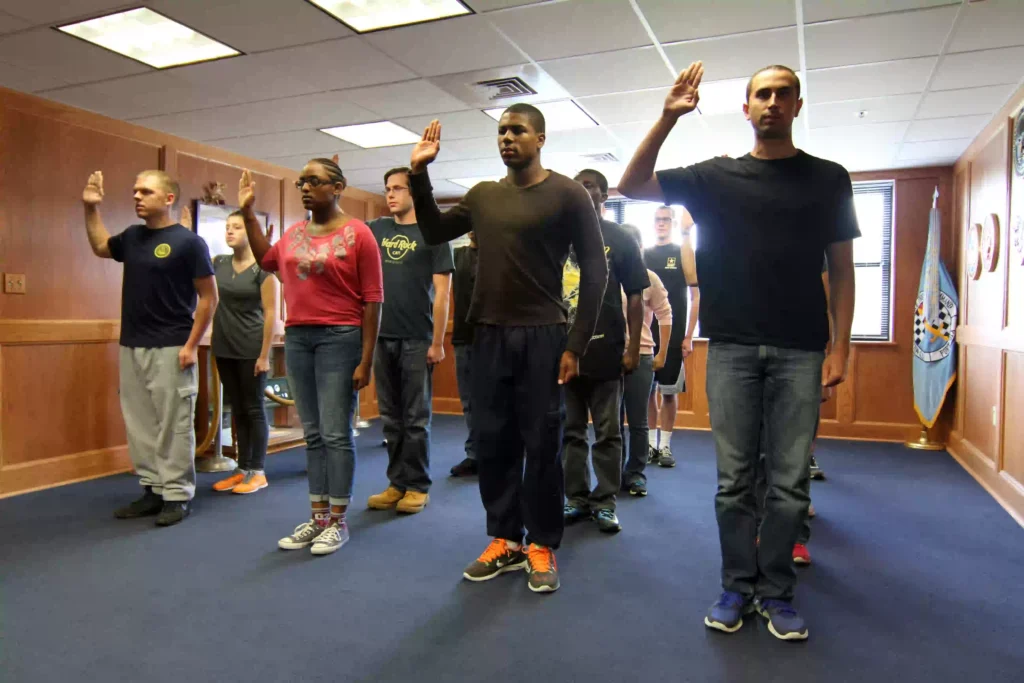
If Congress were to authorize a draft, the Selective Service System would conduct a lottery. Draft-eligible individuals would be assigned a lottery number based on their birthday. Those with lower numbers would be called first.
From there, a classification process would begin. Not all lottery winners would be inducted immediately. Draftees go through medical and psychological screening. Those with disqualifying conditions receive deferments or exemptions. Student deferments, which were widely used during Vietnam, are not guaranteed in any future draft, that policy would need to be established by Congress at the time.
The induction process itself, from lottery to active duty, would take months. The idea that a draft starts and people ship to basic training within days is a misconception built by movies, not policy.
Draft Age: Who Gets Drafted and When?
Current Selective Service law requires males to register between the ages of 18 and 25. The draft age range, who would actually be called in an activation, is typically described as ages 18 to 25, and men who received a deferment remain liable for induction until age 35.
The question “can you be drafted at age 40?” comes up frequently. Under current law, the answer is effectively no, the Selective Service database contains registrants from ages 18 to 25, and liability extends to age 35 only for men who were deferred. There is no legal mechanism to draft individuals over 35 under existing Selective Service statutes.
When Do You Age Out of the Draft?
Men age out of mandatory Selective Service registration when they turn 26. After that birthday, they are no longer required to register, and they would not be included in any draft lottery pool based on current law. Men who registered but turned 26 before a draft were activated would fall outside the eligible pool.
Draft age in the U.S. has varied historically. In World War II, the upper age limit was extended to 44 at certain points. Congress could theoretically change the age limits again through legislation, but doing so would require an active authorization debate.
Women and the Draft: Where the Law Stands
As of 2026, women are not required to register with the Selective Service, and that did not change with the automatic-registration law described above, which applies only to men. This has been a subject of ongoing legislative and legal debate, particularly after the Department of Defense opened all combat roles to women in 2015. The National Commission on Military, National, and Public Service recommended in 2020 that Congress extend registration requirements to women, but no law has been passed to implement that change.
The debate has resurfaced in Congress multiple times since. A Senate Armed Services Committee-passed version of the FY2025 NDAA would have required women to register, and a group of senators led by Josh Hawley publicly opposed that provision, arguing women’s military service has always been voluntary. The provision requiring women to register was ultimately dropped from the enacted FY2025 NDAA, and the FY2026 NDAA’s automatic-registration provision left the male-only requirement untouched. Supporters of extending registration to women have generally framed it as a matter of equal obligation now that combat roles are open to women; opponents have generally argued that voluntary service for women should remain the standard. Neither side has secured enough votes to change the underlying law as of this writing.
The legal status could change with future legislation. Anyone following this issue closely should track Congressional activity on the National Defense Authorization Act, which is where such a change would most likely be introduced.
Is the Draft Coming Back?
This is the question most people are actually asking. The direct answer: there is no current legislation to activate a draft, and the all-volunteer force remains the U.S. military’s preferred manpower model.
A draft would require an extraordinary set of circumstances, a major conflict with manpower needs that volunteer recruitment cannot meet, combined with a Congressional vote and Presidential authorization. Neither condition exists in the current environment. The automatic-registration change taking effect in December 2026 is a modernization of the existing registration database, not a step toward activating a draft; it changes who files the paperwork, not whether a draft happens.
The path to a commission or enlisted career for those interested in voluntary service is covered in detail in our enlisted to officer commissioning guide, which is relevant to anyone considering military service by choice rather than compulsion. Voluntary service carries significant advantages in assignment selection, MOS qualification, and career development compared to what a draft induction would offer.
The Selective Service and Education Benefits
One practical consequence of Selective Service that many young men overlook: failure to register before age 26 can permanently bar you from federal jobs and federal job training, and from some state benefits. Federal student aid is no longer affected; the FAFSA Simplification Act removed that requirement.
For anyone considering military college pathways, schools like Norwich University, the oldest private military college in the country, offer ROTC commissioning paths.
Understanding the intersection of military service, Selective Service registration, and education benefits is part of a broader picture that our military college vs. traditional university comparison covers in more depth. The choices you make at 18 have downstream effects on both your military eligibility and your access to federal education programs.
Your Path to Enlistment
What to Do With This Information
If you are 18 to 25 and male, register with the Selective Service immediately if you have not already done so. The registration takes five minutes online at sss.gov and carries significant practical consequences if skipped. That said, this window is closing: once automatic registration takes over in December 2026, most 18-year-old men won’t need to take this step themselves at all, though confirming your own registration status directly with SSS remains a good idea either way.
If your question about the draft is driven by anxiety about geopolitical events, understand that a draft activation is a multi-step, publicly debated process, not something that happens overnight. The U.S. military’s current strategic posture relies on volunteer forces, and that is unlikely to change absent a conflict of a scale not seen in decades.

William Johnson writes about U.S. military training and enlistment for Servicemembers Opportunity Colleges. His work covers topics such as boot camp, ROTC, the ASVAB test, military pay, and what to expect during basic training, with a focus on giving recruits and their families clear, practical information about military life.
Sources
- Selective Service System. “Official Website.” SSS.gov, 2026.
- Congressional Research Service. “FY2025 NDAA: Selective Service Registration Proposals.” Congress.gov, 2025.
- Military Times. “Automatic registration for US military draft-eligible men to begin in December.” Military Times, April 2026.
- CNN. “Automatic military draft registration takes effect in the US in December 2026. Here’s how it would work.” CNN Politics, April 2026.
- Office of Senator Josh Hawley. “Hawley Leads Colleagues in Opposing Potential NDAA Provision Forcing Women to Register for Draft.” Hawley.Senate.gov, December 2024.