

The National War College (NWC) is a joint senior service college of the National Defense University at Fort Lesley J. McNair in Washington, D.C. It runs a 10-month resident program in national security strategy for selected military officers at the O-5 and O-6 level, senior federal civilians, and international fellows. Graduates earn a Master of Science in National Security Strategy and Joint Professional Military Education (JPME) Phase II credit. This guide covers who attends, how students are selected, the curriculum, the degree, and how NWC compares with the other senior service colleges.
The National War College is where the Pentagon, the State Department, and other federal agencies send a small group of mid-career leaders to study strategy at the national level for one academic year. You cannot apply to it the way you apply to a civilian graduate school. Your service or agency picks you, usually around the 20-year point of a career.
If you are a cadet, a junior officer, or a parent trying to understand where a military career can lead, NWC is one of the top rungs of the officer education ladder. The sections below explain what it takes to get there and what happens once you arrive.

In This Article
- What the National War College Is
- Who Attends and How Students Are Selected
- The Resident Program and Curriculum
- The Degree and JPME Phase II
- Campus, History, and Notable Features
- How NWC Compares With Other Senior Service Colleges
- Career Impact After Graduation
- The Long Road to a Seat at NWC
- Frequently Asked Questions
- Where This Leaves You
What the National War College Is
NWC is one of the colleges of the National Defense University (NDU), the joint university that operates under the Chairman of the Joint Chiefs of Staff. Unlike the Army, Navy, Air Force, and Marine Corps war colleges, it does not belong to any single service. Its focus is national security strategy: how the United States combines diplomatic, informational, military, and economic power to reach its goals.
The college states its mission on its official website this way:
“The National War College mission is to educate joint, interagency, and international leaders and warfighters by conducting a senior-level course of study in national security strategy, preparing graduates to function at the highest levels of strategic leadership in a complex, competitive, and rapidly evolving strategic environment.”
National War College, Mission and Vision (nwc.ndu.edu)
The Department of State is a joint sponsor of the college. According to NWC, State nominates a Foreign Service officer with ambassadorial rank to serve as the commandant’s deputy and international affairs adviser, while the commandant is a one-star officer whose position rotates among the Army, Navy, and Air Force.
Who Attends and How Students Are Selected
The incoming Class of 2027, which reported to Roosevelt Hall in August 2026, has about 200 students drawn from the U.S. government, the armed forces, and international fellows from more than 30 countries, according to the college’s welcome letter.
NWC publishes a fixed mix: 59 percent of the student body comes in equal shares from the land, air, and sea services (sea includes the Marine Corps and Coast Guard). The other 41 percent come from the Department of State, other federal departments and agencies, and international fellows. Seminars are built from that mix, so an Army officer may sit next to a Foreign Service officer, a Marine, and an officer from a partner nation.
Admission requirements by student type
- U.S. military officers: must hold a bachelor’s degree from an accredited school and reach the grade of O-5 (lieutenant colonel or commander) before the academic year starts, with a record of outstanding performance and potential for senior strategic leadership.
- U.S. government civilians: must be comparable in rank and potential to the military students, should hold a graduate degree, and should show potential to serve at the senior executive level. A small number of private-sector students may also attend NDU under federal law (10 U.S.C. 2167).
- International fellows: must be serving military officers or defense civilians at a rank equal to a U.S. O-6 or O-7, graduates of a staff college, with at least 15 years of service, a bachelor’s degree or equivalent, and set English test scores. The Chairman of the Joint Chiefs approves the list of invited countries.
Selection is by your service or agency, not by application
There is no open application. Each military service picks its senior service college students through its own centralized, competitive process, and then slates each selected officer to a specific school, which may be NWC, the Eisenhower School, or a service war college. The Army War College describes these selections as centralized and competitive, with chosen officers typically in the top 10 percent of their peer group. Civilian agencies run their own nomination processes, and international fellows are invited by country through the Joint Staff.
Once selected, incoming students work through their Service or Agency Chair at the college, who acts as their main point of contact before arrival.
The Resident Program and Curriculum
NWC is a full-time, in-residence program at Fort McNair that runs for about 10 months, starting in early August. There is no distance or online version of the NWC degree. NDU’s online graduate option sits in a different college, the College of Information and Cyberspace.
Under the 2026-27 NDU catalog, the degree requires 34 credit hours. The core courses, required for all students, are:
| Core Course (AY 2026-27) | Credits | What It Covers |
|---|---|---|
| NWC-7000 Introduction to Strategic Logic and Joint Warfighting | 5 | Strategic logic, instruments of national power, theories of strategy, and an in-depth study of China |
| NWC-7200 The Evolving Character of War | 4 | Advanced warfighting, from land, sea, and air war to space, cyber, AI, and drones, ending in a peer-adversary wargame |
| NWC-7300 War and Statecraft | 4 | How U.S. departments and agencies combine military and non-military power |
| NWC-7400 Strategic Context | 5 | The international system, the Constitution, civil-military relations, and domestic politics |
| NDU-7010 and NDU-7020 Joint and Combined Warfighting courses | 3 + 3 | Joint force fundamentals, operational design, and contingency and crisis-action planning |
| NWC-7500 Fall Orals and NWC-7600 Spring Orals | 0 | Pass/fail oral exams before a faculty panel; Spring Orals is the college’s capstone assessment |
U.S. students then complete NWC-7100, Applied National Security Strategy and Policy, which focuses on one region or functional issue, such as NATO, China, Northeast Asia, the Arabian Gulf, the Horn of Africa, nuclear strategy, or cyber. That leads into NWC-7150, the National Security Practicum, a capstone in which students build and defend a full strategy against a threat to vital U.S. interests. The practicum uses field research and meetings with leaders from government, the military, industry, academia, and the media, and ends with a formal presentation to senior leaders. U.S. students also take two electives, one in each of the second and third quarters.
Electives change each year. The 2026-27 catalog lists courses such as Nuclear Weapons and National Security in the 21st Century, Negotiations for Strategists, Strategic AI and National Security, and Russia and European Security. International fellows follow a separate track with two American Studies courses and a two-part directed strategy research project.

The program is reading- and writing-heavy, and much of the learning happens in small seminars. Officers who come from technical graduate programs, such as those at the Naval Postgraduate School, often find the shift from engineering problems to policy and strategy problems the biggest adjustment of the year.
The Degree and JPME Phase II
Graduates earn a Master of Science in National Security Strategy, awarded by the National Defense University. NDU is accredited by the Middle States Commission on Higher Education. To graduate, students need at least a 3.0 GPA, a grade of B- or higher in every course, and passing results on both oral exams.
U.S. military graduates also receive JPME Phase II credit. NDU describes JPME II as a major requirement for designation as a Joint Qualified Officer, a qualification that matters for later promotion to general or flag officer. The same JPME II credit is available at the other senior service colleges, including the Naval War College in Newport and the Army War College.
International fellows who meet all requirements can earn the master’s degree. Fellows with limited English skills may choose a diploma track with reduced writing requirements, which does not award the degree.
Campus, History, and Notable Features
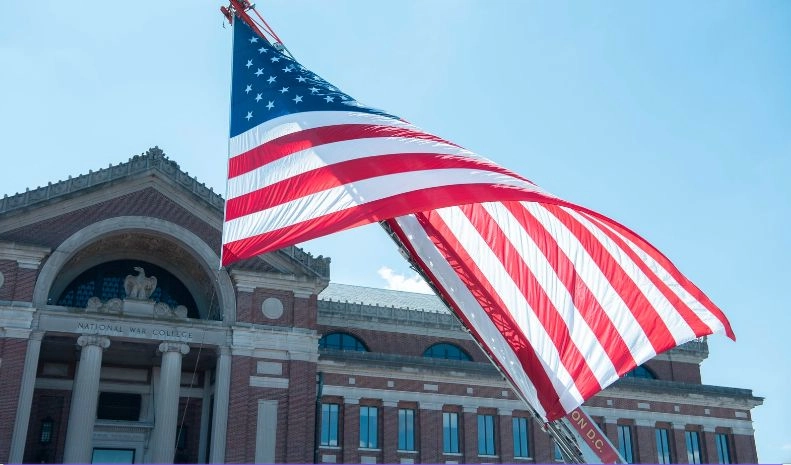
NWC holds classes in Roosevelt Hall at Fort McNair, on the Washington waterfront. The building was completed in 1907 and housed the Army War College until the National War College took it over in 1946. Roosevelt Hall was named a National Historic Landmark in 1972. NWC became part of NDU when the university was created in 1976.
A few features set NWC apart:
- The State Department connection. George F. Kennan was the college’s first senior State Department representative, from 1946 to 1947. His work there fed into the “X Article” that introduced containment, and the college now has a George F. Kennan Chair in National Security Strategy.
- Strategy as the central subject. The Dean of Students’ letter to the Class of 2027 calls NWC the only military service college whose central focus is national security strategy.
- Location. Being in Washington makes it easier to bring in speakers from the Pentagon, State, Congress, and the interagency, and to do field research for the practicum.
- Notable alumni. The NDU catalog notes that Colin Powell is the only National War College graduate who served as both Chairman of the Joint Chiefs of Staff and Secretary of State. The west wing of Roosevelt Hall was dedicated to him in 2016.
How NWC Compares With Other Senior Service Colleges
All six senior service colleges below give U.S. officers JPME Phase II credit and a master’s degree. They differ in sponsor, focus, location, and size. Each service also runs its own college, such as the Army War College at Carlisle Barracks, Pennsylvania.
| College | Location | Students (latest published figure) | Degree | Resident Length |
|---|---|---|---|---|
| National War College (NDU) | Fort McNair, Washington, D.C. | About 200 (Class of 2027) | Master of Science in National Security Strategy | 10 months, from August |
| Eisenhower School (NDU) | Fort McNair, Washington, D.C. | About 330 per year | Master of Science in National Resource Strategy | 10 months, August to June |
| U.S. Army War College | Carlisle Barracks, Pennsylvania | About 340 U.S. JPME II graduates a year, plus about 80 International Fellows | Master of Strategic Studies | Early August to early June |
| Naval War College, College of Naval Warfare | Newport, Rhode Island | 192 senior-course students (AY 2022-23) | Master of Arts in National Security and Strategic Studies | 10 months |
| Air War College | Maxwell AFB, Alabama | About 245 resident students a year | Master of Strategic Studies | July to May |
| Marine Corps War College | Marine Corps Base Quantico, Virginia | Small student body (MCU does not publish a set number) | Master of Strategic Studies | One academic year, August to June |
The closest relative of NWC is its NDU neighbor, the Eisenhower School, which shares Fort McNair but centers its program on resourcing, the defense industrial base, and acquisition, with an industry study in fields such as shipbuilding, space, or munitions. NWC centers on strategy and statecraft. The service colleges each add a service lens: landpower at Carlisle, maritime strategy and wargaming in Newport, airpower at Maxwell.
Don’t confuse any of these with the six senior military colleges, such as Texas A&M or The Citadel. Those are undergraduate schools with a corps of cadets, not graduate war colleges.
Career Impact After Graduation
NWC prepares students for senior policy, command, and staff jobs rather than for one specific next assignment. Many graduates move into senior joint and service staff jobs or O-6-level command, such as a brigade, wing, or major ship or squadron. Flag-level commands such as carrier strike groups come only later, after promotion to admiral.
Common next assignments include the Joint Staff, the Office of the Secretary of Defense, combatant command headquarters, service headquarters, and, for civilians, senior roles back in their home agencies. The JPME II credit and the strategy background help, but they are not a guarantee of promotion. Selection to general or flag officer still depends on performance in the jobs that follow.
The Long Road to a Seat at NWC
No one arrives at NWC straight from a commissioning program. A typical military student has about two decades of service behind them. The usual path looks like this:
- Commissioning. Officers come from every source. Seminars mix graduates of ROTC, Officer Candidate School, and the service academies, including the United States Military Academy and the United States Air Force Academy. Some started as enlisted troops and later used one of the enlisted-to-officer commissioning routes.
- Early career (O-1 to O-3). Branch training, tactical leadership, and a strong evaluation record.
- Intermediate education (O-4). A command and staff college, which typically brings JPME Phase I.
- Command and key jobs (O-5). Battalion, squadron, or ship command, or a key staff position.
- Senior service college selection. A centralized board picks the officer for senior service college, and the service slates them to NWC or another school.
Frequently Asked Questions
Can a civilian apply to the National War College?
Not as a private individual. U.S. government civilians attend when their department or agency nominates them, and they should be comparable in rank to O-5 and O-6 officers and hold a graduate degree. A small number of private-sector students are allowed under 10 U.S.C. 2167.
Do students pay tuition?
Students do not apply or enroll as paying students. They attend on orders or assignment from their service or agency, which keeps paying their regular salary while they study.
Is the National War College degree accredited?
Yes. The Master of Science in National Security Strategy is awarded by the National Defense University, which is accredited by the Middle States Commission on Higher Education. The program is also accredited by the Joint Staff for JPME Phase II.
What is the difference between the National War College and the Naval War College?
The National War College is a joint NDU college in Washington, D.C., focused on national security strategy. The Naval War College is a Navy school in Newport, Rhode Island, with an intermediate college and a senior college. Both are often abbreviated NWC.
Is there an online or distance version?
No. The NWC master’s degree is a full-time, in-residence program at Fort McNair. Officers who need a non-resident senior-level option usually look at a service program, such as the Army War College Distance Education Program.
Where This Leaves You
The National War College is a one-year, fully funded study of national strategy for about 200 selected officers, civilians, and international fellows. It ends with a Master of Science in National Security Strategy and JPME Phase II credit. You don’t apply to it. You earn a nomination through two decades of strong performance, and your service or agency decides where you go. If you are just starting out, the habits that eventually lead to a seat at Fort McNair begin early: good evaluations, broad assignments, and a steady record of professional education.

William Johnson writes about U.S. military training and enlistment for Servicemembers Opportunity Colleges. His work covers topics such as boot camp, ROTC, the ASVAB test, military pay, and what to expect during basic training, with a focus on giving recruits and their families clear, practical information about military life.
Sources
- National War College. “Mission and Vision.” nwc.ndu.edu, 2026.
- National War College. “Attending National War College.” nwc.ndu.edu, 2026.
- National War College. “Dean of Students Welcome Letter, Class of 2027.” nwc.ndu.edu, 2026.
- National War College. “History of the National War College.” nwc.ndu.edu, 2026.
- National Defense University. “AY 2026-27 NDU Catalog.” ndu.edu, 2026.
- National Defense University. “Accreditation.” ndu.edu, 2026.
- Eisenhower School. “Eisenhower Students.” es.ndu.edu, 2026.
- U.S. Army War College. “Academic Program Guide AY25.” army.edu, 2024.
- U.S. Naval War College. “Fast Facts, Academic Year 2022-2023.” usnwc.edu, 2023.
- Air War College. “About.” airuniversity.af.edu, 2026.
- Marine Corps University. “AY 2025-26 MCU Course Catalog.” usmcu.edu, 2025.