

A chain of command is the line of authority that decides who gives orders and who carries them out. It runs from the President down to a single private in the military, and from a CEO down to a front-line hire in business. This article breaks down what chain of command means in practice, why militaries and companies both depend on it, and how to use the same logic at your own job.
A general does not call a private directly. A CEO does not walk onto the factory floor and reassign a technician’s shift. Both scenarios sound like efficiency, but they are actually how organizations fall apart.
The chain of command definition sounds simple on paper: a structured line of authority showing who gives orders and who carries them out. But here’s the thing. Most people only really understand it once they’ve watched what happens when it breaks, whether that’s a mixed signal in a platoon or two managers giving a new hire conflicting instructions on day one.
In This Article
- What Does Chain of Command Mean?
- How Does the Military Chain of Command Actually Work?
- How Does a Chain of Command Work in Business?
- What Does Chain of Command Management Involve?
- Why Is a Chain of Command Important?
- What Do Chain of Command Examples Look Like Across Organizations?
- How Can You Apply Chain of Command Thinking at Work?
- Where This Leaves You
What Does Chain of Command Mean?
A chain of command is the structured line of authority that shows who gives orders and who carries them out, from the top leader down to the smallest unit. Every person in the chain answers to exactly one superior and directs a defined group below them. That single rule, one boss, one set of orders, is what separates a chain of command from a plain org chart.
The formal definition of command hierarchy traces back to military tradition, but you’ll find the same structure anywhere people need to coordinate work without stepping on each other. A hospital has one. A construction crew has one.
So what does chain of command mean for you, practically? It means you know who to ask when something goes wrong, and you know who’s accountable when it does. Nobody has to guess.
Think about it this way. Without a defined chain, three different people might feel entitled to tell you what to prioritize today, and none of them would be wrong to think so. That’s chaos wearing a business-casual outfit.
How Does the Military Chain of Command Actually Work?
The U.S. military chain of command starts at the very top, with the President as Commander in Chief, and it’s written into federal law, not just tradition. Under 10 U.S.C. §162, the operational chain runs from the President to the Secretary of Defense, then down to the commanders of the unified combatant commands.
Below that top layer, each branch runs its own internal structure. The Army, for example, organizes its forces into Army Commands and Direct Reporting Units, each with its own commanding officer and reporting lines. Navy, Air Force, Marine Corps, Space Force, and Coast Guard all mirror the same basic chain of command logic, just with different unit names.
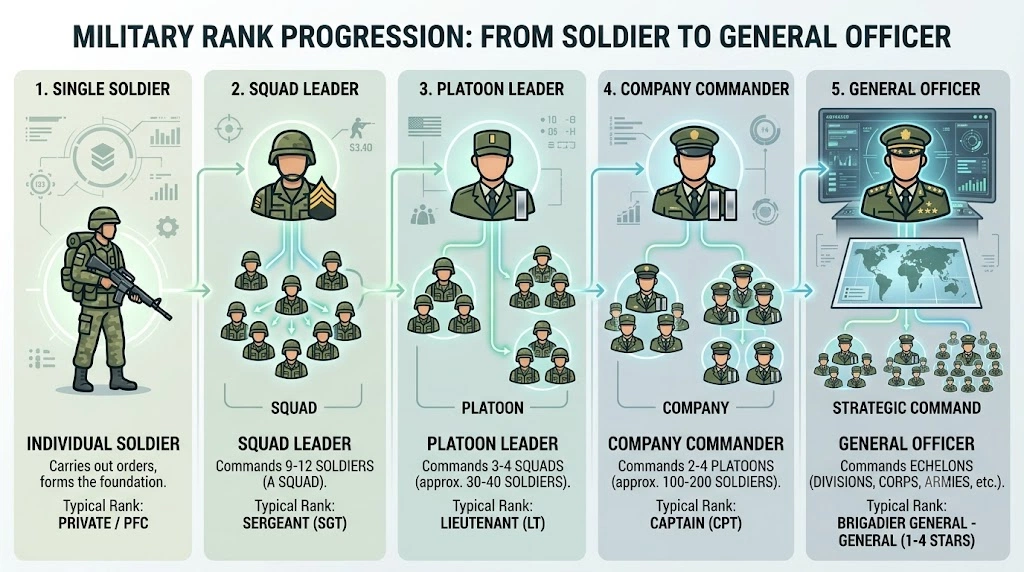
Down at the unit level, things get more personal. Every unit, from a four-Marine fire team led by a corporal to a division of tens of thousands led by a general, has a designated leader; units from company level up are led by a commanding officer, usually supported by an executive officer and senior noncommissioned officers. In my years writing about military life for recruits, this is the piece people underestimate: your actual day-to-day chain of command isn’t the President, it’s your squad leader and platoon sergeant, the people you see every single day.
“Orders are transmitted down the chain of command from a higher ranking Soldier to a lower-ranking Soldier, and are either executed immediately or delegated down the chain of command as appropriate.”
Today’s Military, Chain of Command: Military Hierarchy
Recruits are expected to memorize their local hierarchy of command within the first week or two of arrival, and it’s often the subject of their first written test. You won’t know the exact names ahead of time, since assignments shift, but the pattern never changes: report up through your immediate leader, never around them.
How Does a Chain of Command Work in Business?
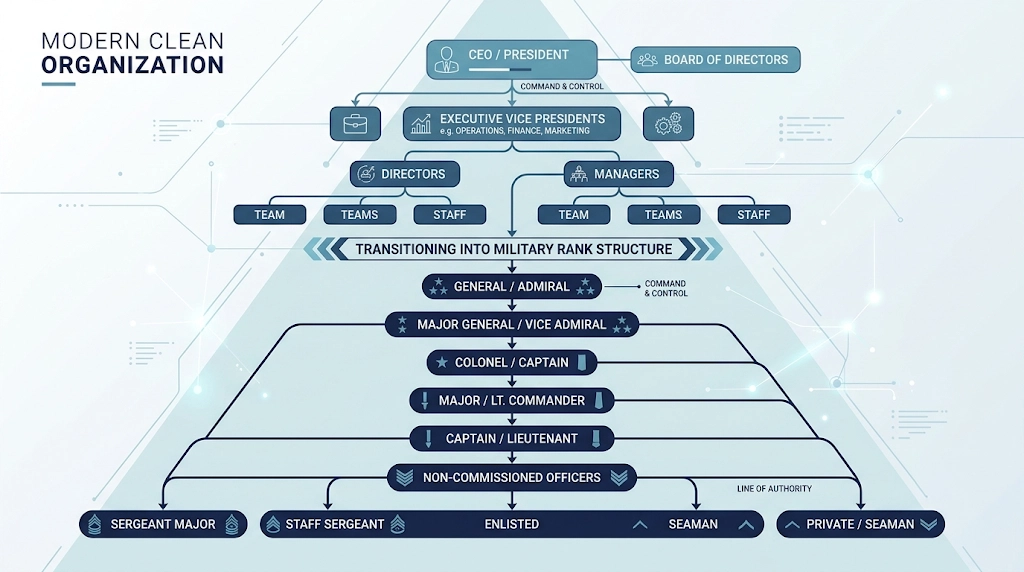
A chain of command in business works the same way it does in the military, minus the salutes. Orders and decisions move down from leadership, and information, problems, and requests move back up. The structure just wears a different uniform: job titles instead of ranks.
Most companies organize their business chain of command into three rough tiers. Here’s the basic breakdown you’ll see in almost any org chart:
- Top-level management: the C-suite, executives, and board of directors, responsible for strategy and high-level decisions
- Mid-level management: department heads and supervisors who translate strategy into day-to-day plans
- Front-line staff: the employees actually executing the work, from sales associates to client-facing roles
Why does this matter beyond looking tidy on a slide? One 2025 industry survey on HR visibility found that nearly half of HR leaders say they lack a clear picture of their own organization’s current structure, and the large majority planned to invest more in tools to fix that gap. A chain of command in business isn’t paperwork, it’s the thing that keeps decisions from getting stuck or duplicated.
What Does Chain of Command Management Involve?
Chain of command management comes down to one core idea that management theorists call unity of command: each employee should receive direction from exactly one superior. It’s not a military-only concept. It’s a century-old management principle, and it’s the reason most companies still avoid having two bosses assign the same person conflicting priorities.
Here’s where it gets interesting. When unity of command breaks down, it’s rarely dramatic, it’s usually two reasonable managers giving the same employee two different priorities without realizing it. The employee ends up stuck choosing which boss to disappoint.
Management chain of command also covers escalation, which is different from bypassing. Good managers train their teams to raise issues at the lowest level that can actually solve them, and only push problems upward when local options are exhausted. That’s how organizations avoid drowning senior leaders in decisions that never needed to reach them.
Why Is a Chain of Command Important?
Why is chain of command important? Because it reduces conflicting orders, clarifies who’s accountable, and lets decisions cascade fast without a debate over who’s actually in charge. Those three things matter just as much in a boardroom as they do in a firefight.
Take a hypothetical order from the top: if the President wanted a barracks painted purple, he wouldn’t call the recruit doing the painting directly. He’d call the Secretary of Defense, who would work it down through the proper Army leadership channels until it finally reached someone holding a paintbrush. That sounds slow, but it’s actually what keeps a huge organization from tripping over itself.
Without a defined chain, senior leaders end up trying to manage everyone directly, which simply doesn’t scale. A general commanding thousands of troops can’t personally direct each one, and neither can a CEO personally manage every front-line employee. The chain of command exists so each leader only has to manage a handful of people directly, who then manage their own handful.
And it gets more complicated. Jumping straight to a senior leader with a routine issue, even with good intentions, undermines the manager in between and often creates conflicting guidance for everyone downstream. That’s true whether you’re in uniform or in a cubicle.
What Do Chain of Command Examples Look Like Across Organizations?
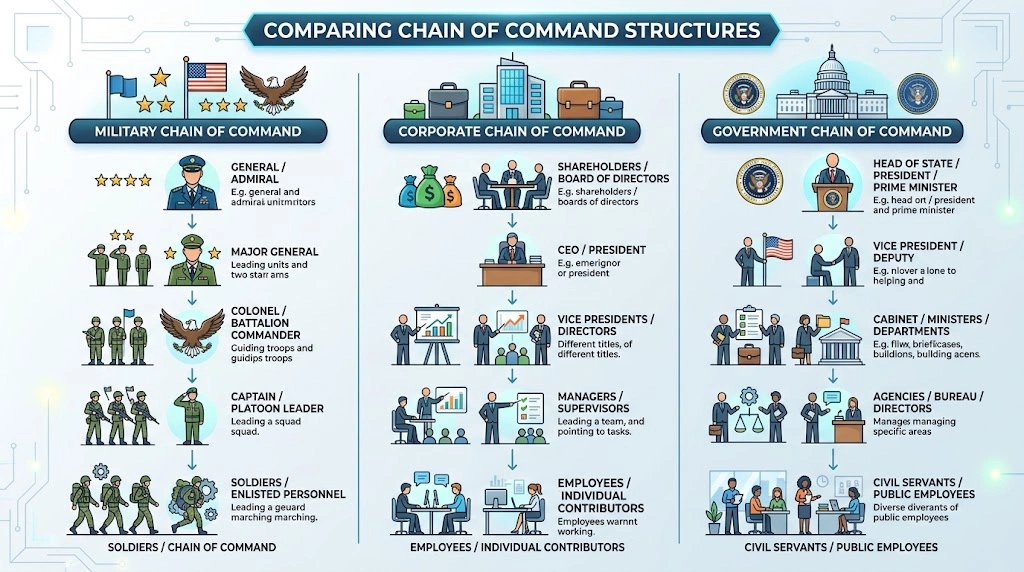
A chain of command example looks different depending on the type of organization, but the underlying pattern, one superior, defined subordinates, stays constant. The table below lays out how the chain of command organizational structure compares across three common settings.
| Setting | Top of the Chain | Typical Flow Downward |
|---|---|---|
| Military | President (Commander in Chief) | Secretary of Defense, combatant commanders (operational) or service secretaries (administrative), unit commanders, NCOs, individual service members |
| Corporate | Board of directors | CEO, division vice presidents, department managers, team leads, individual employees |
| Government agency | President or agency head | Deputy secretary or deputy administrator, assistant secretaries or division heads, regional directors, front-line officers |
Notice what stays the same across all three rows: every level answers upward to exactly one point of contact, and every level directs a defined group below it. That’s the real organization chain of command pattern, not the specific job titles, which change from setting to setting.
How Can You Apply Chain of Command Thinking at Work?
You don’t need a uniform to use chain of command thinking on the job. Veterans transitioning into civilian careers tend to pick this up fast, because the habit of knowing exactly who you answer to and who answers to you is already second nature. Here’s how to apply the same logic at an ordinary job:
- Map your own chain: write down your direct manager, their manager, and anyone who reports to you
- Delegate with specifics: assign one clear owner, a deadline, and a standard, instead of a vague “someone should handle this”
- Escalate, don’t bypass: take issues to your immediate supervisor first, and let them decide whether it needs to go further
- Reserve exceptions for real emergencies: safety issues, ethics violations, or situations where normal channels are simply too slow
Every organization’s culture is different, but the discipline itself transfers everywhere, and if you’re weighing a move from military service into a civilian career, gosoced.org’s military career resources cover the practical side of that shift.
Worth pausing on that for a second. A chain of command in management isn’t about rigid control. It’s about making sure everyone knows exactly where a decision needs to land.
What is a chain of command business structure?
A chain of command business structure is the formal reporting hierarchy that defines who directs whom inside a company. It typically runs from the board of directors and CEO down through vice presidents, department managers, and front-line staff. Every employee has one direct supervisor, and information about problems or results flows back up that same path. It’s essentially the corporate version of the same authority structure used in the military, just with different titles.
What does chain of command mean in the military?
In the military, the operational chain of command runs from the President as Commander in Chief to the Secretary of Defense to the combatant commanders and down to unit commanders; a separate administrative chain runs through the military department secretaries and service chiefs. Every service member has exactly one direct superior and reports problems through that same line. Recruits are taught to memorize their local chain almost immediately after arrival. It’s treated as foundational knowledge, not an afterthought.
What is an example of a chain of command?
A classic chain of command example is a soldier who reports to a squad leader, who reports to a platoon leader, who reports to a company commander, and so on up through the ranks. A corporate version looks similar: an employee reports to a team lead, who reports to a department manager, who reports to a vice president, who reports to the CEO. In both cases, each person answers to exactly one superior above them. The pattern repeats at every level, all the way to the top.
Why is chain of command important in the workplace?
Chain of command is important in the workplace because it prevents conflicting instructions, clarifies who is accountable for what, and lets decisions move through the organization without constant debate over authority. Employees know exactly who to approach with questions or concerns instead of guessing. Managers can delegate confidently, knowing responsibilities are clearly assigned. Without it, even small teams tend to drift into confusion and duplicated effort.
Where This Leaves You
A chain of command isn’t red tape. It’s the reason a massive organization, military or corporate, can move fast without everyone stepping on everyone else’s decisions. One person gives direction, a defined group carries it out, and problems travel back up through the same clear path.
But the real question is this: do you actually know your own chain? Most people can name their direct manager without thinking, but plenty couldn’t tell you who that manager answers to, or who on their own team is counting on clear direction from them.
Take five minutes and map it out. Once you can see your own chain of command clearly, on paper or in your head, delegating, escalating, and just getting work done stops being a guessing game.
Sources
- Congressional Research Service. “Defense Primer: Department of the Army and Army Command Structure.” Congress.gov, 2025.
- U.S. Army. “The U.S. Army’s Command Structure.” Army.mil, 2026.
- Today’s Military. “Chain of Command – Military Hierarchy.” Todaysmilitary.com, 2026.
- Military.com. “Basic Training Chain of Command.” Military.com, 2021.
- Wikipedia contributors. “Command hierarchy.” Wikipedia, 2026.

William Johnson writes about U.S. military training and enlistment for Servicemembers Opportunity Colleges. His work covers topics such as boot camp, ROTC, the ASVAB test, military pay, and what to expect during basic training, with a focus on giving recruits and their families clear, practical information about military life.