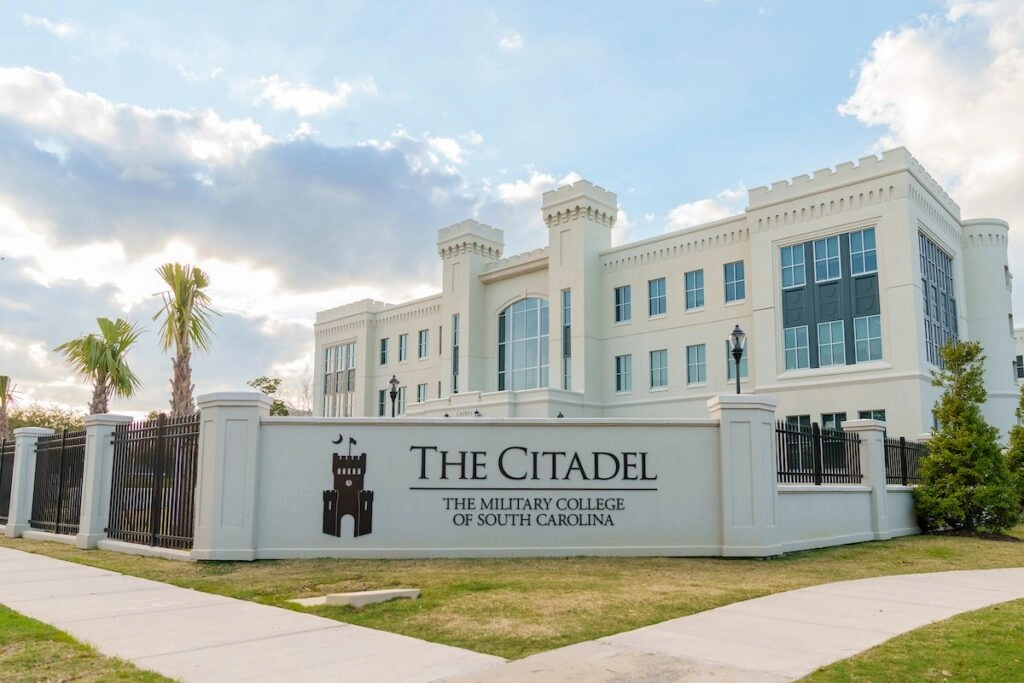

The Citadel acceptance rate sits at roughly 93 percent according to the most recent, most corroborated data, though you will find sites reporting numbers as low as 23 percent. This guide explains why those figures disagree, breaks down real admissions criteria and total cost, and compares The Citadel against VMI so you know what you’re actually working with.
Search for The Citadel’s acceptance rate and you’ll get answers that don’t agree with each other. One site says 93 percent, another says 23 percent. That’s not a typo on either end.
It comes down to which dataset a site pulled from and when. Below, we walk through the current, verifiable numbers first, then explain the gap, then cover The Citadel’s admissions process, its tuition and full cost, and how it compares with VMI, the comparison prospective cadets ask about most.
In This Article
- What Is The Citadel Acceptance Rate, and Why Do Sources Disagree?
- How Selective Is The Citadel Military College, Really?
- How Does Citadel Admissions Evaluate Applicants?
- What Does The Citadel Tuition and Total Cost Actually Include?
- What SAT, GPA, and Test Scores Do Admitted Cadets Have?
- The Citadel vs VMI: How Do the Two Senior Military Colleges Compare?
- Does Getting In Guarantee a Military Career?
- Where This Leaves Prospective Cadets
What Is The Citadel Acceptance Rate, and Why Do Sources Disagree?
The most current, cross-checked figure puts The Citadel’s acceptance rate at about 93 percent. That number comes from four separate sources that agree closely: US News reports a 93 percent acceptance rate, CollegeData reports the same 93 percent based on 3,282 applicants, and College Board’s own BigFuture profile lists 92.8 percent. PrepScholar independently lands on 92.8 percent too.
But here’s the thing. Niche lists The Citadel’s acceptance rate at 23 percent, sourced from IPEDS federal data. That’s not a small rounding difference, it’s a completely different number, and it’s the one that trips up a lot of families doing quick research.
So what does that actually mean for you? Treat the roughly 93 percent figure as the reliable one to plan around, since it’s corroborated by four independent, currently updated sources. The 23 percent figure likely reflects an older reporting cycle or a narrower slice of the applicant pool, and no site currently explains that gap.
How Selective Is The Citadel Military College, Really?
Here’s where it gets interesting. A 93 percent acceptance rate makes The Citadel sound close to open admission. In practice, that’s roughly accurate for academic screening, but it’s not the whole selectivity story.
Only about a quarter of admitted students actually enroll. CollegeData’s numbers show a yield of 24 percent among admitted applicants, meaning most students who get in choose to go elsewhere. That’s the real filter at The Citadel: getting past academic review is fairly achievable, but committing to the Corps of Cadets lifestyle is what actually narrows the field.
Here’s how the main data sources compare for The Citadel:
- US News: 93 percent acceptance rate, admitted SAT range 1085 to 1285
- CollegeData: 93 percent of 3,282 applicants admitted, 24 percent yield
- BigFuture (College Board): 92.8 percent acceptance rate, SAT 1100 to 1270
- Niche (IPEDS): 23 percent, the clear outlier among current sources
Because the academic bar is relatively low, admissions officers lean harder on fit and readiness for a regimented environment than on raw test scores. That’s a different kind of selective, and it’s worth understanding before you assume a 93 percent rate means an easy four years.
How Does Citadel Admissions Evaluate Applicants?
Citadel admissions requires an online application, official high school transcripts, and supporting materials like recommendations and activity records. Standardized test scores are considered if you submit them, but The Citadel doesn’t require SAT or ACT scores outright.
Academic readiness matters, but so does demonstrated leadership and evidence you can handle a structured, disciplined daily schedule. According to The Citadel’s official admissions page, the school looks for applicants who show both academic preparation and genuine motivation to thrive inside the Corps of Cadets system, not just a strong transcript.
“Admissions decisions weigh a student’s high school coursework, GPA and class rank, and evidence of leadership and character alongside any test scores submitted, all measured against fit for the Corps of Cadets.”
The Citadel, Office of Admissions
Campus visits and Admitted Student Day events are strongly encouraged before you commit. Here’s the part most people miss. Seeing a formation in person, sitting through a meal in the mess hall, or shadowing a cadet for a day tells you more about fit than any acceptance rate ever will.
What Does The Citadel Tuition and Total Cost Actually Include?
The Citadel’s tuition for the 2026 to 2027 academic year runs $13,140 per year for South Carolina residents and $40,407 per year for non-residents, according to the school’s official 2026-2027 tuition table. That’s the number most articles stop at. But there’s a catch.
Tuition alone isn’t the full cost of The Citadel. Corps of Cadets students also pay Room and Board, a Leadership Lab Fee, and a Quartermaster Deposit that covers uniforms and gear. None of those are optional for cadets living in barracks, which is essentially all of them.
| Cost Component | SC Resident | Non-Resident |
|---|---|---|
| Annual Tuition | $13,140 | $40,407 |
| Room and Board | $11,245 | $11,245 |
| Leadership Lab Fee | $1,150–$1,250 | $1,150–$1,250 |
| Quartermaster Deposit | $9,300 freshman / $3,124 upperclass (charged every year) | $9,300 freshman / $3,124 upperclass (charged every year) |

Add it up and the real 2026-27 cost for an in-state cadet is about $34,900 for a freshman ($13,140 tuition + $11,245 room and board + $1,250 Leadership Lab + $9,300 Quartermaster) and about $28,700 for an upperclassman, before books and personal expenses. Out-of-state families are looking at about $62,200 for the freshman year and about $55,900 a year after that, according to The Citadel’s tuition and fees page.
Worth pausing on that for a second. Tuition-only comparisons hide roughly $15,500 to $21,800 a year in mandatory charges.
What SAT, GPA, and Test Scores Do Admitted Cadets Have?
Admitted cadets typically carry a GPA around 3.79 and a composite SAT near 1180, based on the 25th to 75th percentile range reported by College Board’s admissions profile. The middle 50 percent of admitted students scored between 1100 and 1270 on the SAT, or 22 to 27 on the ACT.
Those numbers put The Citadel in a comfortable range for a solid B-plus to A-minus high school student, not a stretch for a top-of-class applicant. If you took AP or IB coursework, that will strengthen a weighted GPA and signal you can manage college-level work under pressure.
The short answer? It depends less on hitting a magic score and more on showing a complete picture: coursework rigor, leadership activities, and a class rank that reflects consistent effort rather than one strong semester.
The Citadel vs VMI: How Do the Two Senior Military Colleges Compare?
The Citadel and VMI get compared constantly because they’re the two senior military colleges built mainly around a full-time Corps of Cadets, while Norwich, Texas A&M, Virginia Tech, and UNG embed their Corps in a larger civilian student body. Both put cadets through a regimented first year and both commission officers, but the numbers diverge in a few places.
VMI’s own admissions summary shows it admitted about 81 percent of first-year applicants in Fall 2023 (988 of 1,221), well above the low-60s to 71 percent figures some sites report, such as the VMI’s acceptance rate listing on Niche, which is the same kind of source disagreement we flagged for The Citadel earlier. Out-of-state tuition is close at the two schools, with VMI slightly higher.
| Metric | The Citadel | VMI |
|---|---|---|
| Acceptance Rate | ~93% (current sources) | ~81% (Fall 2023, VMI data) |
| In-State Tuition | $13,140/year | ~$10,368/year (2025-26) |
| Out-of-State Tuition | $40,407/year | ~$41,960/year (2025-26) |
| SAT Middle 50% | 1100–1270 | 1040–1260 |
The practical difference comes down to location and academic mix as much as anything else. The Citadel sits in coastal Charleston with strong business and engineering programs, while VMI’s Shenandoah Valley setting leans more heavily into engineering and liberal arts. Neither is meaningfully harder to get into on paper, so fit and program strength should carry more weight than the acceptance rate alone.
Does Getting In Guarantee a Military Career?
No. Getting admitted to The Citadel does not commit you to military service after graduation. About one in three cadets actually earns a commission into the U.S. Armed Forces, according to the school’s own admissions materials.
But the real question is this: why does a military-style school have such a low commissioning rate? The answer is that The Citadel functions as a leadership development institution first, with the Corps of Cadets experience, discipline, and structure applying to every student regardless of whether they pursue ROTC and a commission or head straight into a civilian career.
That distinction matters for families weighing The Citadel against a service academy like West Point or Annapolis, where commissioning is mandatory. At The Citadel, you can absorb the leadership training and discipline without a service obligation waiting at graduation, which is exactly why so many cadets choose it over a federal academy.
What GPA do you need to get into The Citadel?
Admitted students at The Citadel typically carry a GPA around 3.79 on the reported scale, though that number reflects the average, not a hard cutoff. A mix of A’s and B’s, with more A’s than B’s, puts you in a reasonably competitive position. Taking AP or IB classes helps too, since it shows admissions officers you can manage rigorous coursework. There’s no published minimum GPA requirement, so a slightly lower GPA paired with strong leadership activities and a clear fit for the Corps of Cadets can still work in your favor.
Is The Citadel hard to get into?
Academically, no. Current, corroborated data from US News, CollegeData, and College Board all put The Citadel’s acceptance rate around 92 to 93 percent, which is far from selective on paper. What’s genuinely demanding is completing the first year and adapting to the regimented Corps of Cadets lifestyle, which is a different kind of challenge than clearing an admissions bar. Plenty of academically qualified applicants get in and then decide the daily structure isn’t the right fit, which is part of why yield sits around 24 percent.
How much does The Citadel cost per year with room and board?
For South Carolina residents, mandatory charges (tuition, room and board, Leadership Lab Fee and Quartermaster Deposit) total about $34,900 for freshmen and $28,700 for upperclassmen in 2026-27, before books, personal expenses, or financial aid. Non-residents pay about $62,200 for the freshman year and $55,900 a year after that. The Quartermaster Deposit, which covers uniforms and gear, is charged every year ($9,300 for freshmen and $3,124 for upperclassmen), so the freshman year costs about $6,200 more than later years. Scholarships, ROTC benefits, and need-based financial aid can bring the net price down significantly for many families.
Do all Citadel cadets have to join the military after graduating?
No, military service is not mandatory for Citadel graduates. Roughly one in three cadets earns a commission into the Armed Forces, while the rest transition directly into civilian careers using the leadership training and discipline built during their four years. This sets The Citadel apart from federal service academies like West Point, Annapolis, or the Air Force Academy, where a service commitment is required upon graduation. Many cadets choose The Citadel specifically because it offers military-style structure and leadership development without locking them into a post-graduation service obligation.
Where This Leaves Prospective Cadets
The Citadel’s acceptance rate isn’t really the number to obsess over. At roughly 93 percent, academic admission is achievable for most applicants with a solid B-plus average and a genuine willingness to live inside a structured, disciplined system.
What actually separates families who thrive at The Citadel from those who transfer out is honest self-assessment about fit, not test scores. Visit campus if you can, talk to current cadets, and look past the tuition sticker price to the full cost of attendance before you commit.
If you’re comparing The Citadel against other senior military colleges or service academies as part of a broader search, our other military college admissions guides break down acceptance rates, costs, and admissions criteria the same way, school by school, so you can compare apples to apples before you apply.

William Johnson writes about U.S. military training and enlistment for Servicemembers Opportunity Colleges. His work covers topics such as boot camp, ROTC, the ASVAB test, military pay, and what to expect during basic training, with a focus on giving recruits and their families clear, practical information about military life.
Sources
- The Citadel. “Tuition and Fees 2026-2027.” The Citadel, 2026.
- U.S. News & World Report. “The Citadel Admissions.” US News Best Colleges, 2026.
- The Citadel. “Admissions.” The Citadel, 2026.
- CollegeData. “The Citadel Acceptance Rate.” CollegeData (Peterson’s), 2026.
- College Board. “The Citadel Admissions.” BigFuture, 2026.
- Niche. “The Citadel Admissions & Acceptance.” Niche, 2026.
- Niche. “Virginia Military Institute.” Niche, 2026.